Future Conflict (Minor)
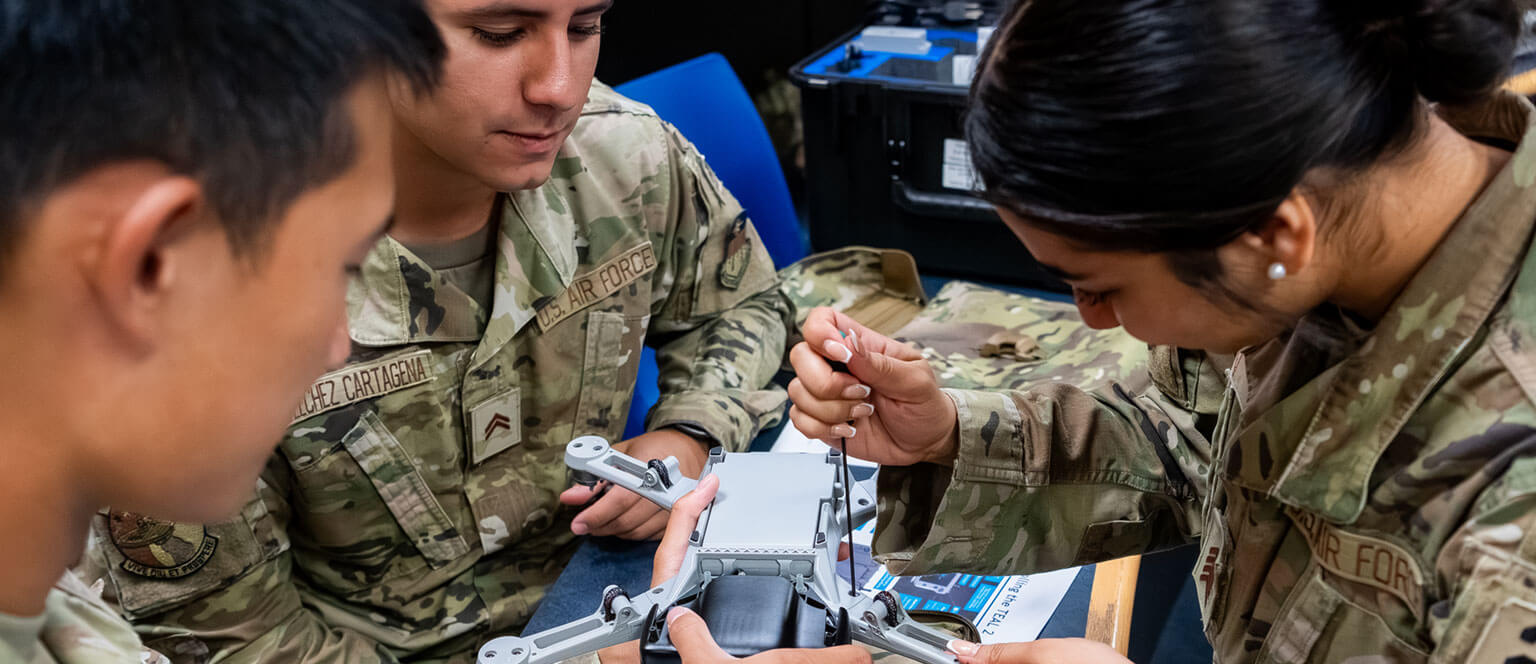
Militaries that assess changes in the character of war, anticipate emerging challenges, and align force design and strategy accordingly are best positioned to succeed in future conflict. Achieving these aims requires officers who combine substantive knowledge with rigorous foresight, strategic and critical thinking, and the audacity to innovate. The interdisciplinary Future Conflict Minor develops these essential capabilities, preparing cadets to adapt and lead across the full spectrum of future operational environments.
As geopolitics, threats, and Department of War priorities evolve, particularly amid rapid technological change and open innovation, the minor emphasizes continual assessment of the strategic environment, adversaries, and U.S. capabilities. Through a structured sequence of courses, cadets examine the U.S. approach to strategic competition, adversary doctrine and strategy, and analytical methods for envisioning future conflict, culminating in a classified practicum that integrates classroom learning with real-world application.
Elective courses allow cadets to deepen their understanding of strategic drivers or gain technical insight into emerging technologies and weapon systems. Grounded in national strategy and future conflict trends, the program fosters prudence, adaptability and strategic judgment in future officers.
Upon completion of the Future Conflict Minor curriculum, cadets will be equipped to:
- Responsibly analyze the changing character of war and its impact on operational environments and concepts.
- Leverage standing knowledge of adversary doctrine and strategy to construe how others think and act, possessing the mental flexibility to incisively red-team into the future.
- Critique and prescribe U.S. strategies for competition and conflict across the full spectrum of conflict and instruments of power.
- Integrate knowledge and skills to solve tangible, wicked-hard problems as determined by Department of War and Air Force sponsors.
- Compellingly communicate innovative courses of action into corridors of decision-making and action through written and oral means.
Potential Job Assignments
| Within the Air Force | Outside the Air Force |
|---|---|
|
|
Sample Courses
Strategic Competition
Adversary Doctrine
Fiction and Future Conflict
AI Hardware Applications
Leading Innovation
History of Unconventional Warfare
American Foreign and National Security Policy
Suggested Course Sequence
Track 1: Technology, Tactics and Tools
| Biology 365 | Biotech |
| Civ Engr 351 | Civil Engineering Practices – Field Engineering |
| Civ Engr 356 | Introduction to Sustainability |
| Chem 325 | Space Chem |
| Chem 350 | Chemistry of Weapons |
| Comp Sci 220 | Data Structures and Systems Programing |
| Comp Sci 471 | Artificial Intelligence (dependent on Comp Sci 220) |
| Comp Sci 472 | Autonomous Systems Integration (dependent on Comp Sci 471) |
| ECE 343 | Electromagnetics |
| ECE 386 | AI Hardware Applications |
| ECE 447 | Communication Systems |
| Geo 488 | Geospatial Intelligence |
| History 321 | STEM at War |
| Law 495 | Law and Emerging Technology |
| Mgt 391 | Business Data Analytics |
| MSS 302 | Future Conflict and Disruptive Technologies |
| Philos 320 | Ethics and Technology |
| Physics 242 | Quantum |
| Physics 310 | Principles of Nuclear Science |
| Pol Sci 462 | Politics & Intelligence |
| Pol Sci 466 | Cyber Security Policy |
| Pol Sci 465 | US Space Policy |
Track 2: Critical Thinking
| BehSci 314 | Influence and Persuasion in Future Conflict |
| BehSci 435 | Judgment, Decision Making, and Augmented Cognition |
| Econ 411 | Introduction to Game Theory |
| Econ 480 | Defense Economics |
| English 370 | Special Topics in War and Literature |
| Mgt 400 | Leading Innovation |
| Philos 311 | War, Morality, and the Military Profession |
| Pol Sci 427 | Great Power Rivalry: Russia & China Foreign Policy |
| Pol Sci 390 | International Relations Theory |
Track 3: Changing Character of War
| BehSci 358 | The Sociology of War and Violence |
| Civ Engr 363 | Humanitarian Engineering |
| Econ 454 | Development and Conflict |
| Geo 250 | Human Geography |
| English 411 | War Stories |
| History 240 | Russia and Eurasia |
| History 250 | Middle East and North Africa |
| History 270 | Modern East Asia |
| History 322 | Conquest of a New Frontier |
| History 324 | History of Unconventional Warfare |
| History 325 | Ancient and Medieval Warfare |
| History 333 | History of Military Thought and Strategy |
| Mgt 476 | Logistics |
| Pol Sci | 423 War Crimes & Genocide |
| Pol Sci | 496 Causes of War |
| Pol Sci | 464 Regime Change |
Track 4: National Security and Strategy
| Biology 495 | Climate and Conflict |
| Econ 374 | Survey of International Economics |
| Econ 450 | International Economics |
| Geo 375 | Geography of International Conflict |
| History 323 | Sea Power and Modern Warfare |
| History 340 | America and the World |
| History 345 | The American Way of War |
| Law 419 | Space Law |
| Law 440 | Cyber Law |
| Mgt 448 | Power and Influence |
| MSS 490 | Strategy in Asia and the Pacific |
| MSS 491 | Strategy in the Americas |
| MSS 493 | Strategy in Eurasia |
| MSS 494 | Strategy in the Middle East and Africa |
| Meteor 352 | Climatology |
| Pol Sci | 302 American Foreign and National Security Policy |
| Pol Sci | 460 Civil-Military Relations |
CONTACT US
Dr. Paul Bezerra
Deputy Head for Academics
paul.bezerra@afacademy.af.edu
(719) 333-9433