Arctic security research takes cadets beyond the classroom
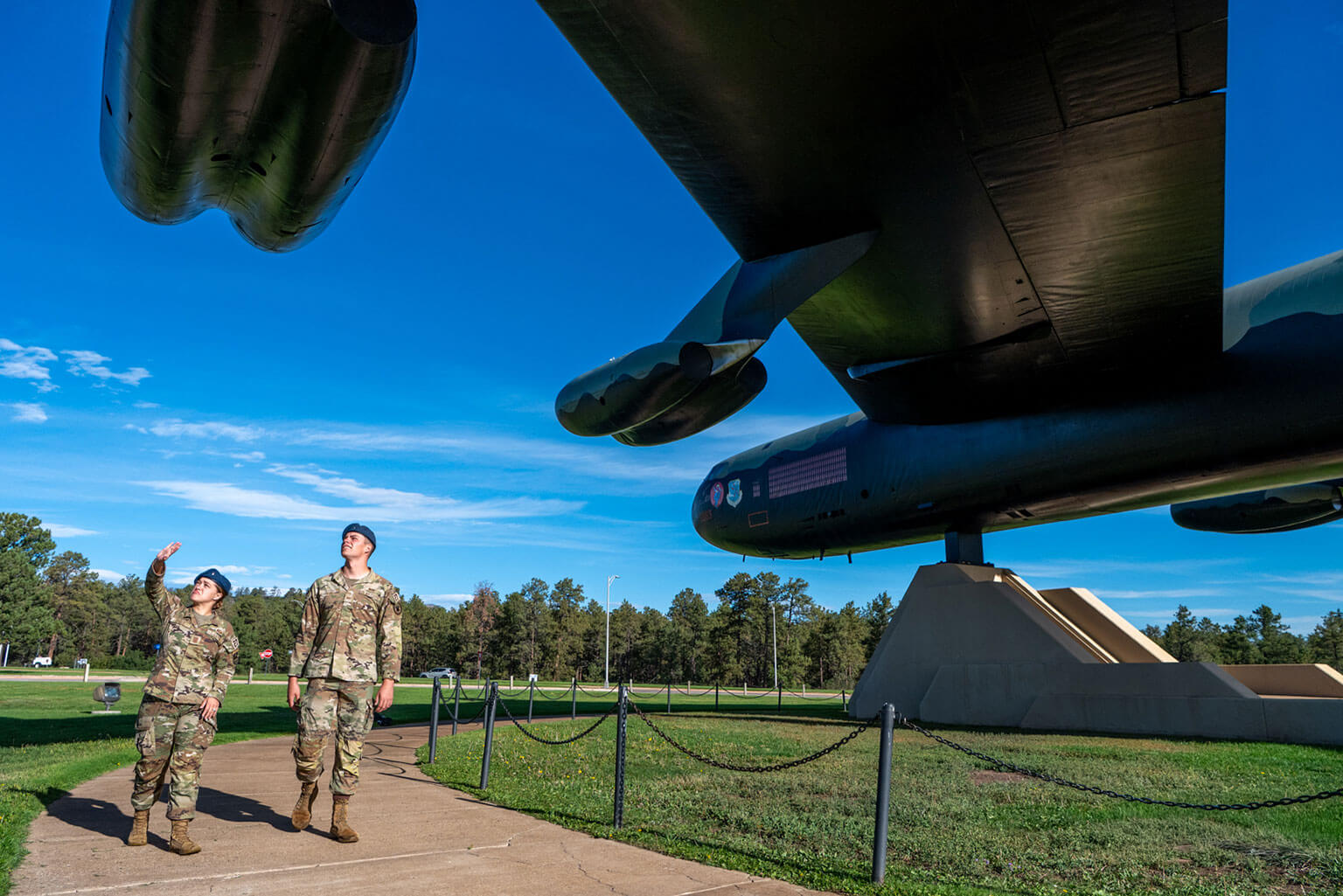
Cadet 1st Class Katherine Longuil, left, and Cadet 1st Class Gavin Dustin, right, walk beneath a B-52 Stratofortress at the U.S. Air Force Academy, Colo., Sept. 16, 2026. As part of their Homeland Defense Institute experience, the cadets explored strategic bombing and its role in the broader history of homeland defense.
By SSgt Michael Ward
U.S. Air Force Academy Strategic Communications
U.S. AIR FORCE ACADEMY, Colo. – U.S. Air Force Academy cadets explored Arctic security through the Homeland Defense Institute (HDI), researching Russian and Chinese activity in the region and engaging with military organizations, researchers and regional stakeholders across Alaska.
The Homeland Defense Institute is a collaboration between the Academy, the North American Aerospace Defense Command and U.S. Northern Command focused on advancing homeland defense through strategic education, research and partnerships.
For this experience, HDI partnered with the Ted Stevens Center for Arctic Security Studies, which oversees the cadets’ research and connects them with Arctic security experts and organizations.
Connecting cadets with homeland defense missions
HDI connects cadets with homeland defense organizations and missions through partnerships across the Arctic and High North.
Jesse L. Johnson Jr., deputy director of HDI, said these experiences help cadets develop an understanding of homeland defense that extends beyond concepts taught in the classroom.
“Experiential research is essential to HDI’s mission because it transforms homeland defense from an abstract concept into lived understanding,” said Johnson. “These experiences expose cadets to real operational environments, real stakeholders and real challenges, something no classroom can fully replicate.”
Cadet 1st Class Gavin Dustin’s interest in Russian and Eastern European history began after he was assigned Russian to fulfill his foreign language requirement during his freshman year. Now a Foreign Area Studies major with a minor in Russian, Dustin used the research opportunity to apply his academic interests to Arctic security research.
In Alaska, Dustin helped develop a website focused on current Russian ambitions and capabilities in the Arctic. Additionally, he visited military installations and communities throughout the state, including Joint Base Elmendorf-Richardson, Nome and Utqiagvik.
Studying strategic competition in the Arctic
While Dustin focused on Russian activity in the Arctic, Cadet 1st Class Katherine Longuil studied China’s activity in the region.
“I engaged with a plethora of sources and people to learn more about the history of what China has done in the Arctic, what they are currently doing, how China engages with Russia and what that could mean,” said Longuil.
Johnson said the Arctic is one of HDI’s three core focus areas because of its growing importance to strategic competition.
“The Arctic is one of HDI’s three core focus areas because it is rapidly becoming a decisive arena for strategic competition,” said Johnson. “It is not just a remote region. It is a frontline.”
Johnson said the region’s geography, resources and increasing military and commercial activity have made it an important area of study for homeland defense. Changes in Arctic accessibility are also increasing opportunities for competitors to operate near North America, he said.
Studying those issues in Alaska gave cadets an opportunity to connect geopolitical concepts with the Arctic’s physical and cultural environment.
Learning beyond the classroom
Traveling through Alaska allowed Dustin to see cultural and geographic similarities between Alaska and the Russian region he had studied academically.
“I learned how many ways Siberia and Alaska are really the same part of the world,” said Dustin. “There was something about seeing the Orthodox crosses in rural Alaska, hearing Russian spoken on the street, being in the forest of Denali and realizing that it’s the same forest that’s over in Russia.”
Dustin also visited the former Nike Missile Site on Joint Base Elmendorf-Richardson, where a conversation with a soldier who had been stationed there during the Cold War gave him insight into the threat posed by Soviet bombers and how homeland defense challenges have evolved over time.
“It was really striking to speak to a soldier who was stationed there during the Cold War and realize how real of a threat Soviet bombers were in the early Cold War,” said Dustin.
Longuil gained a different perspective through interactions with Arctic security researchers. When she encountered difficulty identifying connections between China and the Arctic, another researcher studying the region helped her develop a broader strategic context.
“He gave me phenomenal mentorship that helped me make some much larger connections and see the bigger picture from a strategic aspect,” said Longuil.
Johnson said those interactions help cadets develop skills that extend beyond research itself.
“Classroom instruction can teach concepts, but experiences like this teach perspective,” said Johnson. “Cadets gain operational realism, interagency and binational exposure, applied problem-solving and strategic awareness.”
Preparing future homeland defenders
The experience also shaped how cadets view the responsibilities they will assume after commissioning.
Longuil said studying homeland defense in an operational environment helped her recognize the importance of working across organizations and communicating with partners as an officer. “Being able to research through HDI has given me lots of real-world experience, getting to sit in on upper echelon briefings and learning how to make cross branch connections,” said Longuil. “I didn’t realize how much officership was joint force work and strategic communications with others, which has prepared me even more to commission.”
Dustin said his experience in Alaska also changed how he views the Arctic’s role in international relations.
“My experience in Alaska has made me much more cognizant of the growing importance of the Arctic region,” said Dustin. “I think it is a part of the world that is often overlooked in discussions of international relations.”
Johnson said experiences like these give cadets early exposure to the complexity of homeland defense and help prepare them to operate across the defense enterprise.
“By engaging directly with NORAD and USNORTHCOM mission partners, cadets gain the mindset and skills required to operate in a dynamic security environment,” said Johnson. “They leave with a deeper understanding of the homeland they will soon be responsible for defending.”