Academic minors broaden cadets’ perspectives beyond their majors
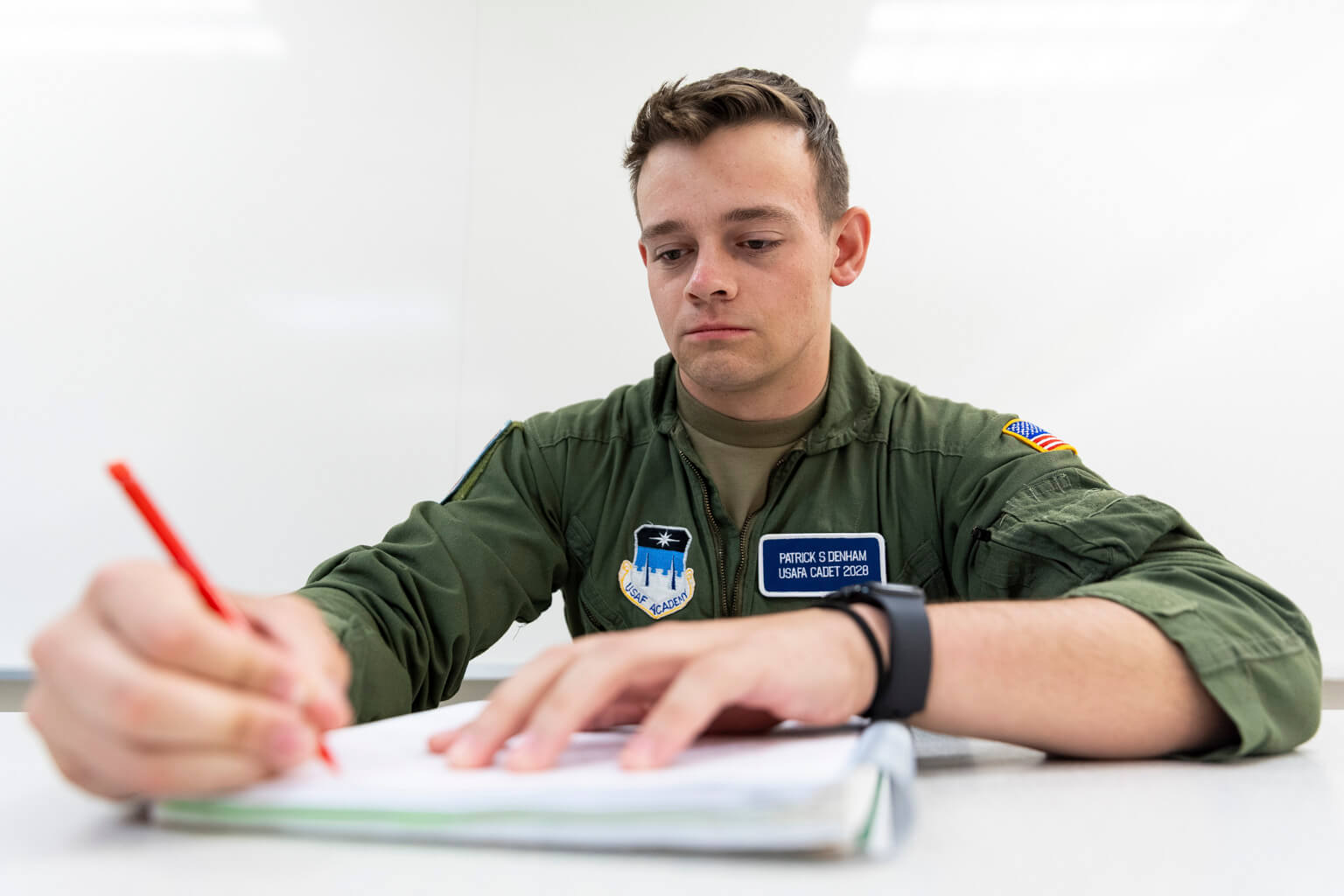
U.S. Air Force Academy Cadet 2nd Class Patrick Denham takes notes during a philosophy class at the Academy in Colorado Springs, Colorado, Oct. 22, 2026. Denham, a Systems Engineering major, is pursuing minors in French and Religion Studies to explore language, philosophy and religious traditions beyond his technical field. (U.S. Air Force photo by Ray Bahner)
By SSgt Brandon Schneider
U.S. Air Force Academy Strategic Communications
U.S. AIR FORCE ACADEMY, Colo. – U.S. Air Force Academy cadets broaden their education beyond their chosen majors through academic minors that allow them to explore different disciplines and develop broader perspectives as future Air Force and Space Force officers.
The Academy offers 22 academic minors, providing cadets opportunities to explore subjects beyond their primary majors.
“A minor affords cadets the opportunity to expand the scope of their thinking and also allow them to interact with other cadets outside their specific major course of study,” said Jill Harris, U.S. Air Force Academy senior associate provost.
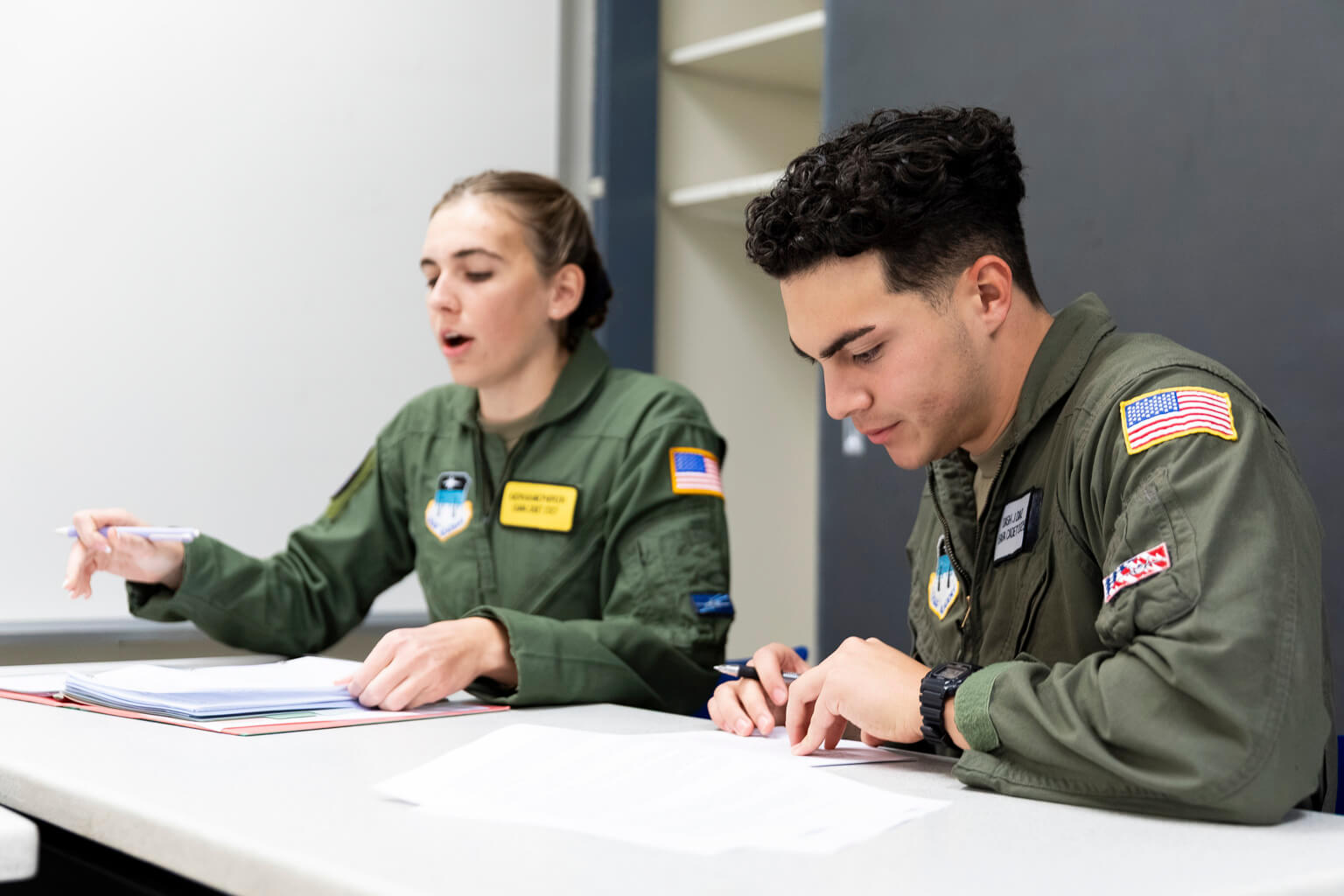
U.S. Air Force Academy cadets participate in a C.S. Lewis and Philosophy class at the Academy in Colorado Springs, Colorado, Oct. 22, 2026. The course examines philosophical arguments and themes in C.S. Lewis’s writings, allowing cadets to explore ideas beyond their primary fields of study. (U.S. Air Force photo by Ray Bahner)
Connecting fields of study through research
Cadet 2nd Class Erin Akins, a Legal Studies major pursuing a French minor, combines her interests in language, culture and law through independent research.
Akins began learning French in elementary school and developed an interest in French-speaking cultures, particularly in West Africa. In a comparative constitutional law course, she examined Senegal’s constitutional right to education and the cultural factors surrounding it, incorporating interests developed through her French minor into her law coursework.
“Studying these cultures has taught me appreciation of differences and to challenge my assumptions,” Akins said.
Akins also applied for the Stamps Scholars Program, which supports research and other educational opportunities. Her proposed project would examine how legal systems can support education that reflects local cultures in French-speaking West Africa.
She plans to pursue a career as a judge advocate and sees her interdisciplinary education as preparation for leading people with different backgrounds and perspectives.
“It teaches me to not jump to conclusions about the people I’m leading and how to understand vastly different world views,” Akins said.
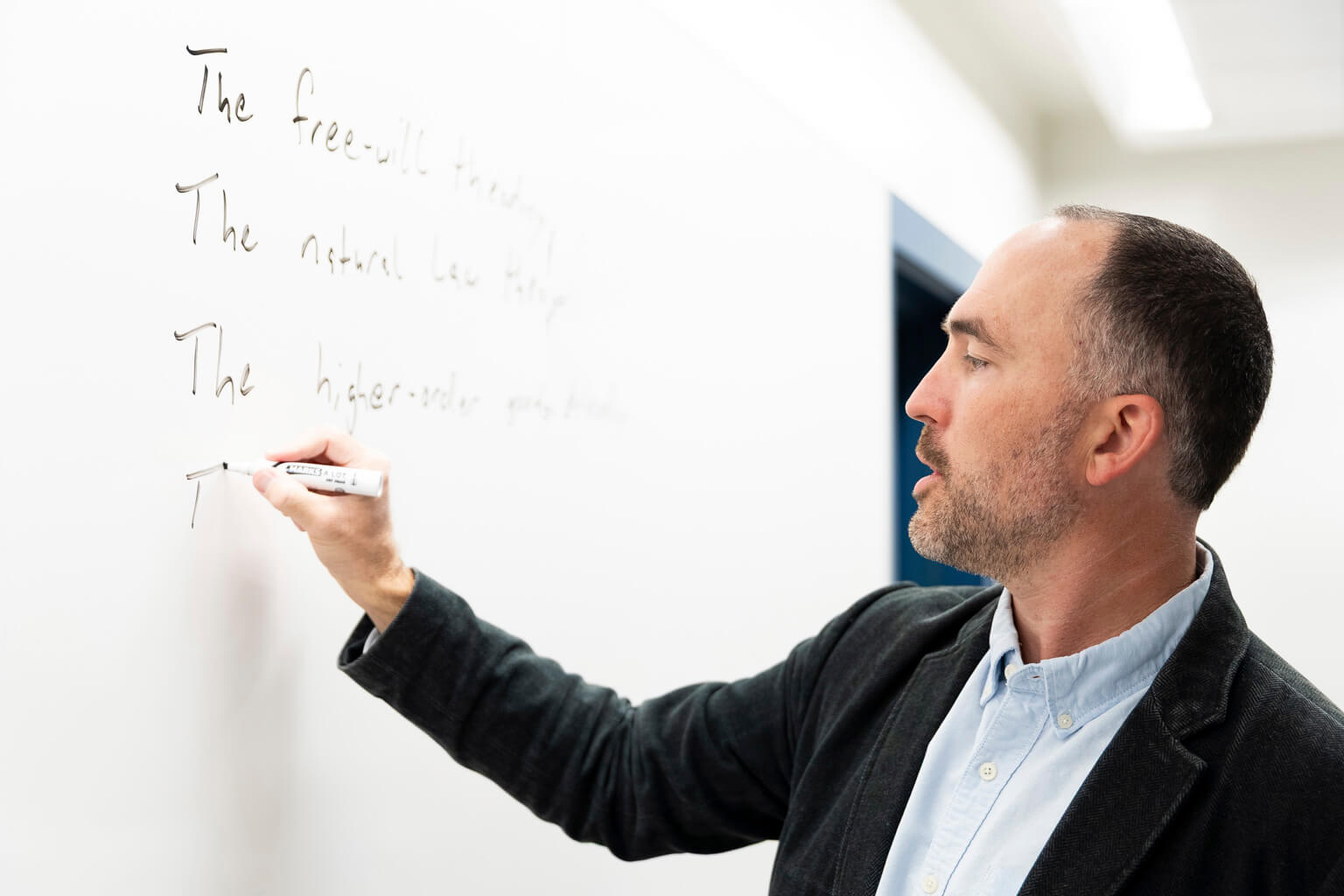
Adam Pelser, a professor of philosophy at the U.S. Air Force Academy, writes on a whiteboard during a C.S. Lewis and Philosophy class in Colorado Springs, Colorado, Oct. 22, 2026. The course examines philosophical arguments and themes through the writings of C.S. Lewis, offering cadets opportunities to explore subjects beyond their primary fields of study. (U.S. Air Force photo by Ray Bahner)
Pursuing academic interests beyond engineering
Cadet 2nd Class Patrick Denham, a Systems Engineering major on the mechanical engineering track, pursues minors in French and Religion Studies to explore his interests in language, religion and philosophy.
“I chose Religion Studies because I am deeply passionate about religion and philosophy, and I wanted to take the opportunity to formally study a subject that genuinely interests me while at the Academy,” Denham said.
Through his comparative religion course, Denham examined religious and philosophical traditions from around the world and reconsidered assumptions shaped by his own experiences.
“This course challenged me to recognize those assumptions and approach other religious traditions with greater openness and curiosity,” Denham said. “By pursuing a rigorous STEM major, a language minor and a philosophical minor, I have intentionally structured my education to incorporate multiple academic perspectives.”
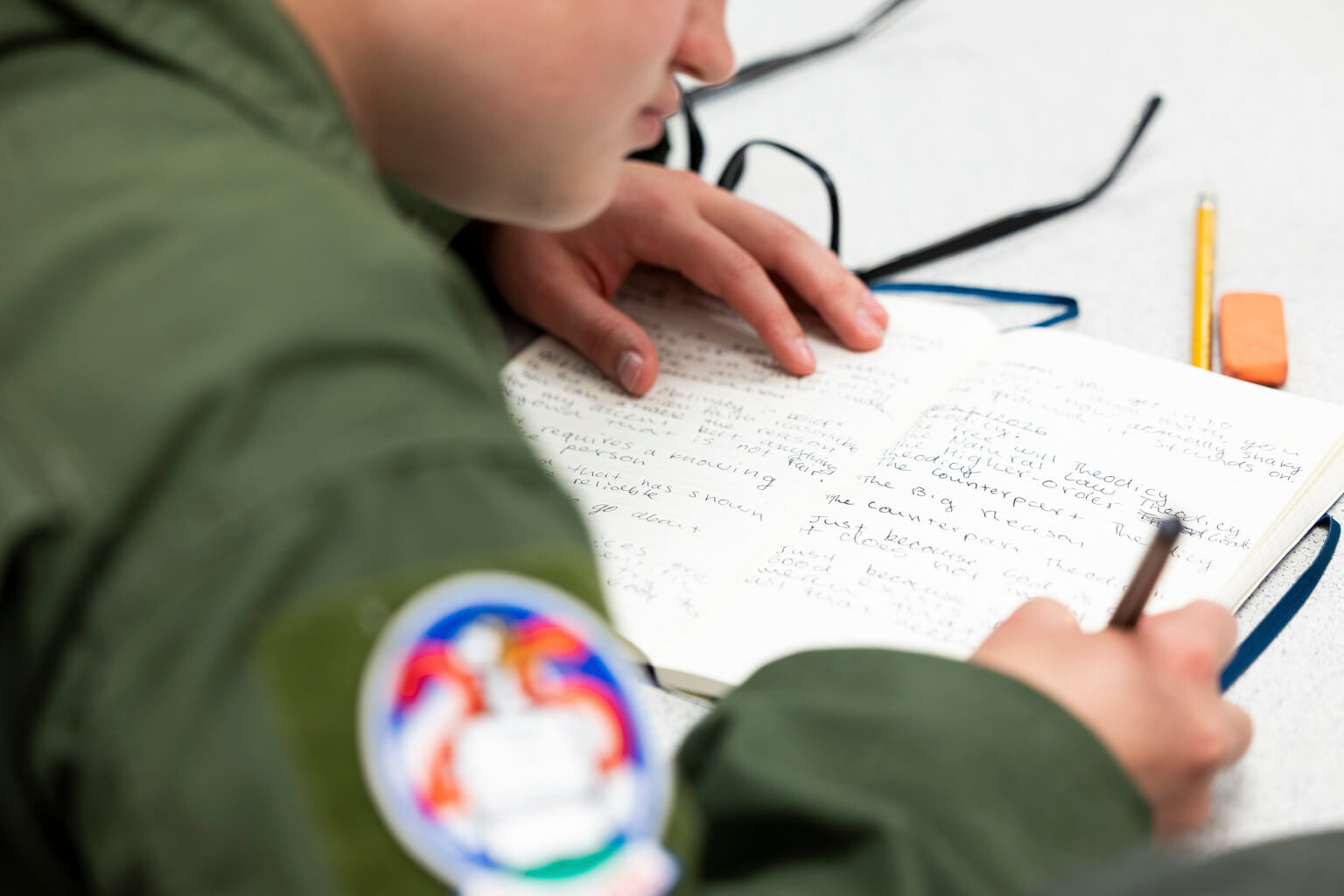
A U.S. Air Force Academy cadet takes notes during a C.S. Lewis and Philosophy class at the Academy in Colorado Springs, Colorado, Oct. 22, 2026. The course examines philosophical ideas through the writings of C.S. Lewis, giving cadets opportunities to engage with subjects beyond their primary fields of study. (U.S. Air Force photo by Ray Bahner)
Preparing for future leadership
Denham’s French minor has provided opportunities to connect with future military leaders from other nations. This semester, he shares a room with a French exchange cadet, an experience he said has helped him better understand the French military and build a friendship with a future French officer.
For Akins, studying different cultures through her French minor has influenced how she approaches leadership decisions. She said she has learned to ask questions and consider multiple viewpoints before determining a course of action.
“As a leader, my minor has taught me to inquire deeply before forming any conclusions,” Akins said. “When interacting with people I’m leading, I start with an open mind and ask lots of questions before deciding what course of action would be best.”
Denham also emphasized the importance of understanding the people he will lead.
“Technical competence and sound decision-making are incredibly important, but so is the ability to understand and lead people with empathy and an appreciation for their individual perspectives,” Denham said.
See more photos on Flickr and take a virtual tour of the Academy’s academic and research facilities.