Cadets focus on science, technology, engineering and mathematics
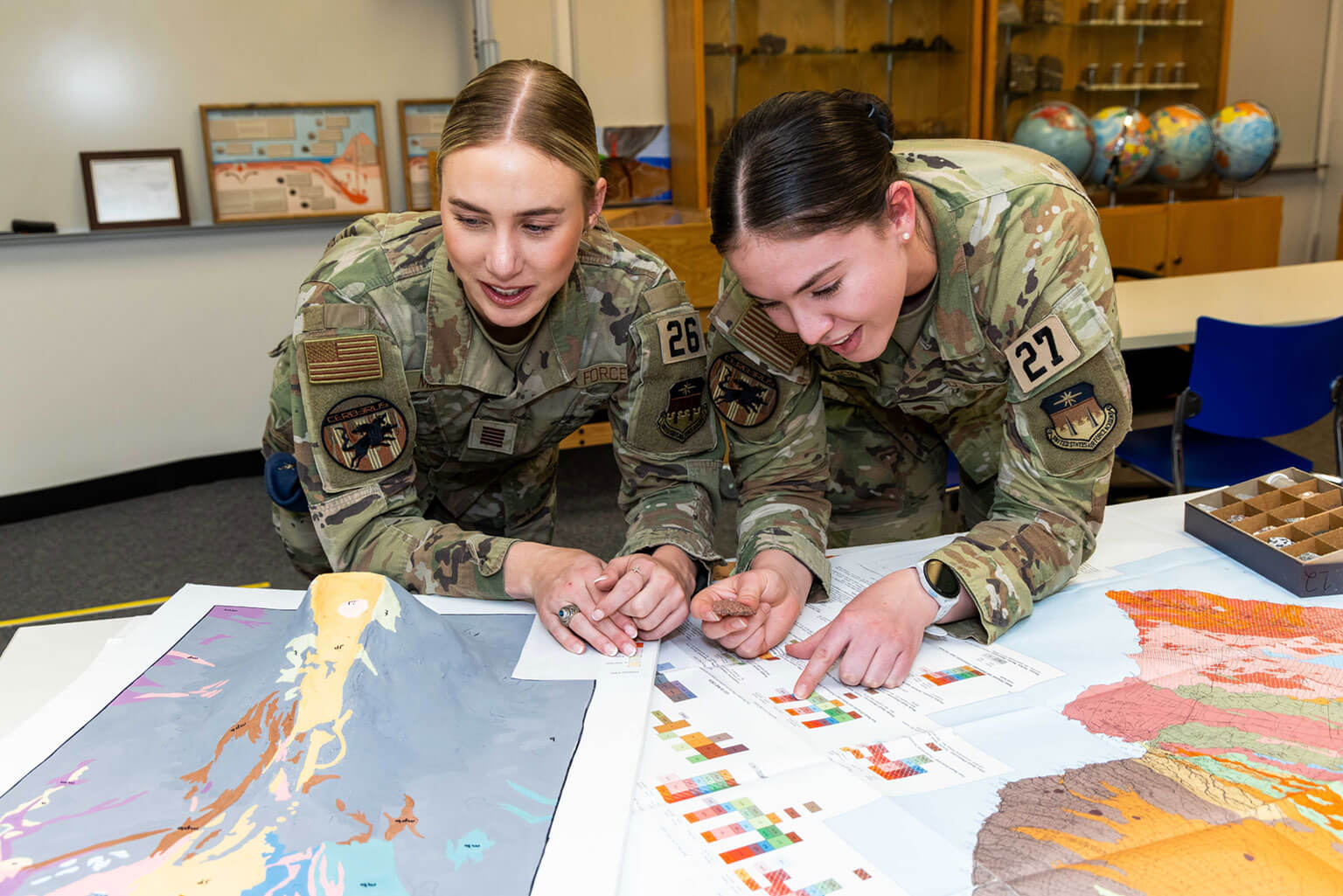
Cadet 1st Class Lauren Mirande, left, and Cadet 2nd Class Abigail Anderson, right, learn about volcanic rock types in the Geospatial Science Laboratory, at the U.S. Air Force Academy, Colo., March 19, 2026. Mirande and Anderson are learning to interpret and analyze data for future operations. (U.S. Air Force photo by Trevor Cokley)
By Harry Lundy
U.S. Air Force Academy Strategic Communications
U.S. AIR FORCE ACADEMY, Colo. – The U.S. Air Force Academy is a leading science, technology, engineering and mathematics institution, frequently ranked among the nation’s top STEM programs. Cadets develop analytical thinking, creativity and problem-solving skills to operate in a rapidly evolving technological environment.
Graduates must be agile thinkers and creative problem-solvers who can meet future challenges in the air, space and cyberspace domains. The Academy provides a rigorous academic foundation to support Air Force and Space Force missions.
Chemistry
Chemistry majors like Cadet 1st Class Emily Adair study concepts that form the foundation for applications in medicine, air, space and rocket propulsion and nuclear and biological treaty compliance testing. Adair said what appeals to her most is how chemistry explains the world at the molecular level.
“The most significant project I have worked on is a small molecular sensor,” Adair said. The sensor shows promise as a cost-effective method for detecting chemical warfare agents.
“My goal is that this work will serve as a foundation for future cadets to incorporate its use operationally, providing better protection for military personnel through faster detection,” she said.
Adair has learned to view setbacks as opportunities for adjustment, rather than dead ends, using them to move forward when experiments yield unexpected results.
“In chemistry, we troubleshoot problems by making adjustments,” Adair said. “I will carry this mindset into the operational Air Force, showing the importance of growing from lessons learned.”
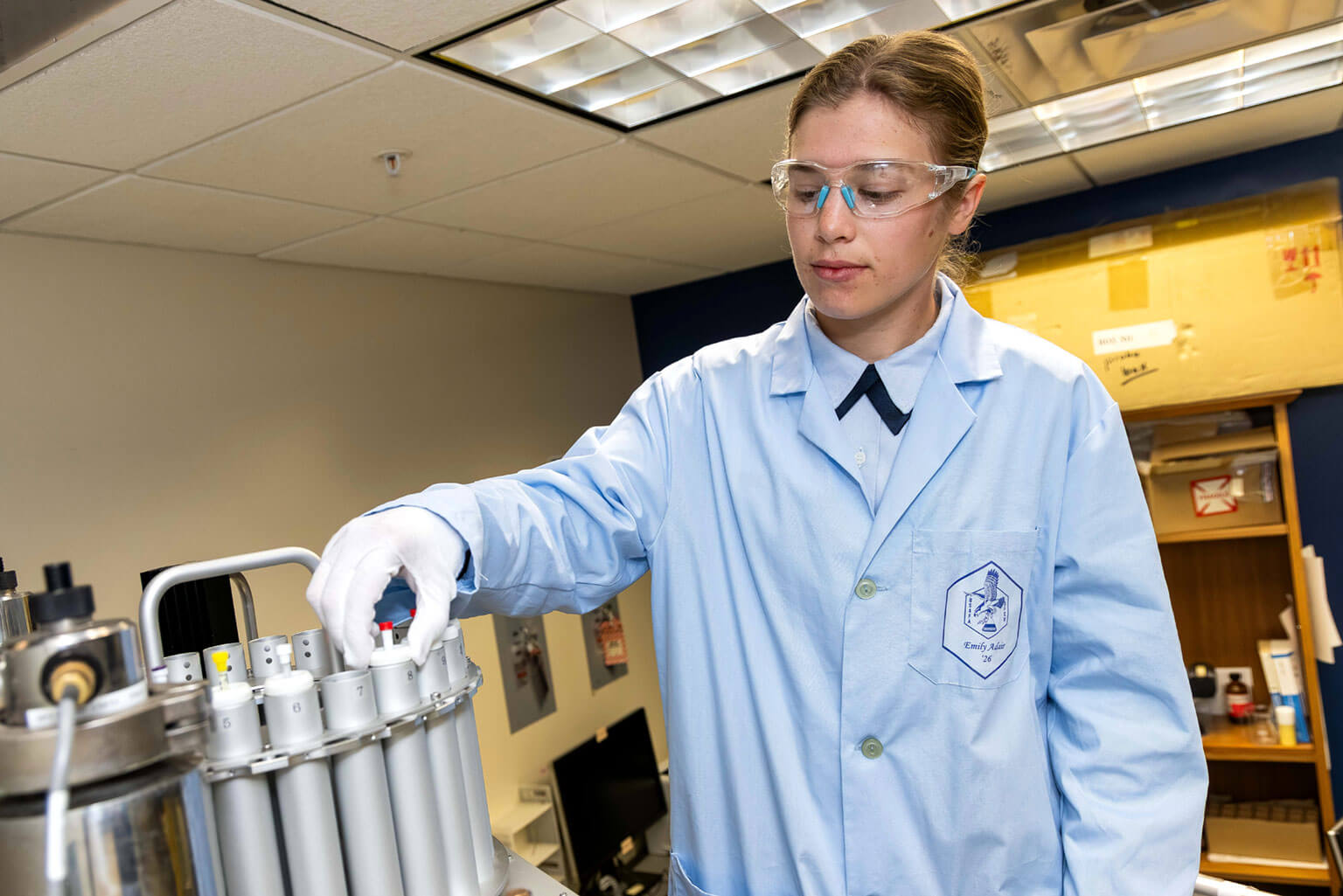
Cadet 1st Class Lauren Mirande examines volcanic rock in the Geospatial Science Laboratory, at the U.S. Air Force Academy, Colo., March 19, 2026. Mirande is learning the importance of terrain in military operations. (U.S. Air Force photo by Trevor Cokley)
Geospatial science
Geospatial science majors like Cadet 1st Class Lauren Mirande use technology and geographic expertise to analyze complex data and make informed decisions that shape the future of the Air Force and Space Force.
“Declaring this major is one of the best decisions I have made,” Mirande said. “It is highly hands-on, project-based and involves field trips that reinforce classroom learning.”
Mirande applied her geoscience skills during a three-week Cadet Summer Research Program internship at the University of Alaska Fairbanks Geophysical Institute. She used a remote imaging sensor to survey mountains and identify subsurface minerals and resources, discovering an abundance of hydrogen with growing potential as a clean energy source.
She later learned the Air Force had issued a request for information on hydrogen’s value to the military.
“Knowing that the Air Force is interested in the energy dependence and long-term sustainability of hydrogen made my work feel valuable,” she said.
Through geosciences, Mirande studies Earth as an ever-changing, dynamic system. Her courses help her understand its present state, examine the history that has shaped it and analyze the forces that will shape its future.
“This awareness shapes how the military understands the environment and conducts operations to remain ahead of our adversaries,” Mirande said.
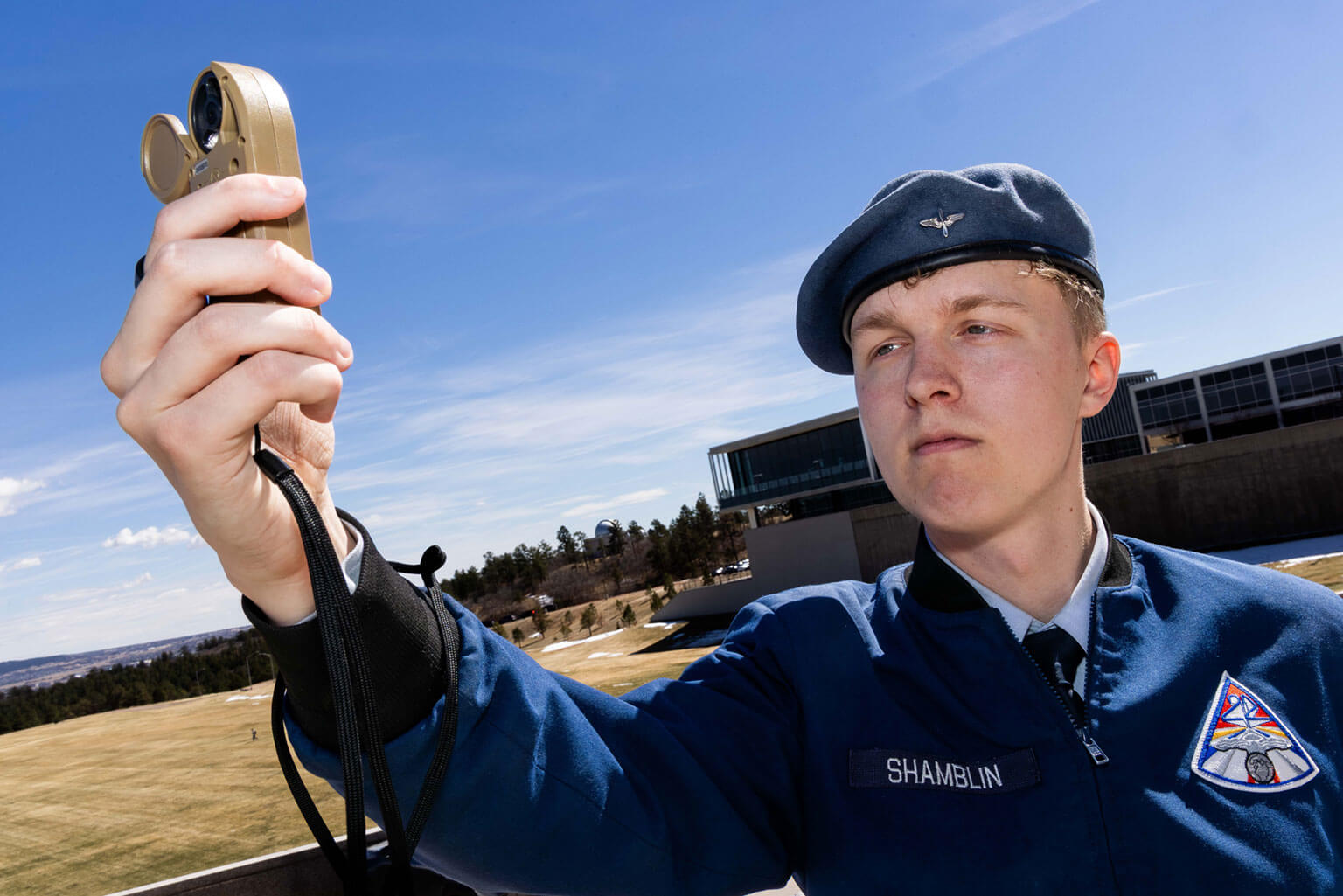
Cadet 1st Class Wyatt Shamblin uses an anemometer to check surface winds before launching a weather balloon at the U.S. Air Force Academy, Colo., March 17, 2026. Shamblin is learning the effects of weather on aircraft performance. (U.S. Air Force photo by Trevor Cokley)
Meteorology
Meteorology majors like Cadet 1st Class Wyatt Shamblin learn to make decisions that affect operations such as airstrikes and space launches. Throughout history, weather has played a role in the outcomes of conflicts and will continue to do so.
Cadets use critical thinking to analyze charts and weather models, and equations to predict atmospheric behavior. “We learn about the effects of weather and the importance of providing accurate information to ensure mission success,” Shamblin said.
As a first-class cadet, Shamblin appreciates the small, six-person class sizes in the major.
“We are a tight-knit group that values teamwork and builds each other up,” Shamblin said. “We are learning the importance of weather and the value of making the right call, even when it is unpopular.
See more photos of our cadets in action across STEM on Flickr.