Lt. Gen. Tony D. Bauernfeind Retires, Closing 34-Year Career, From Cadet to Air Commando and Academy Superintendent
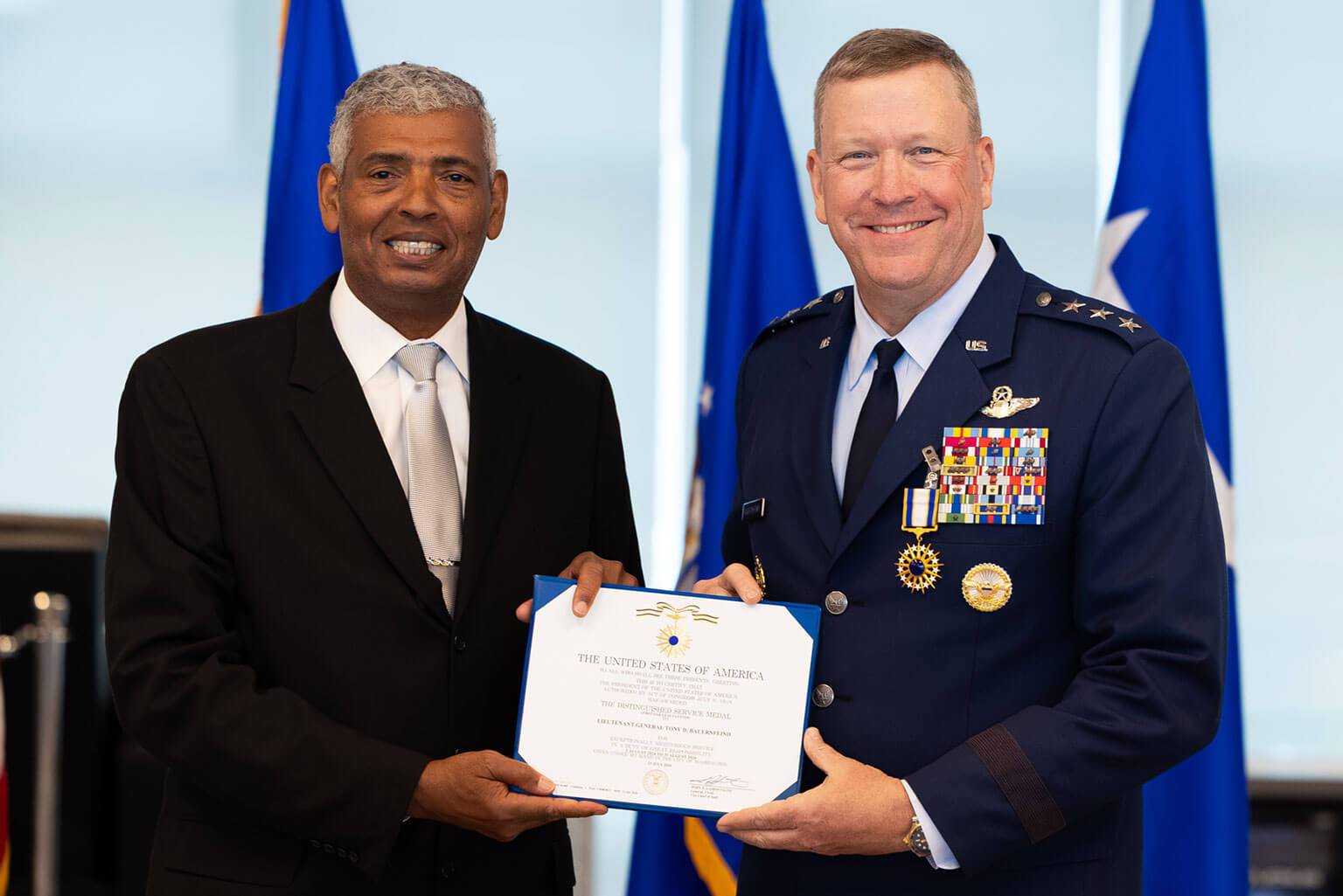
Retired U.S. Army Gen. Vincent K. Brooks, left, presents the Air Force Distinguished Service Medal to Lt. Gen. Tony D. Bauernfeind during Bauernfeind’s retirement ceremony at the U.S. Air Force Academy, Colo., Aug. 7, 2026. The ceremony marked the culmination of more than three decades of service that took Bauernfeind from the cockpit of MC-130 Combat Talons to the highest levels of Air Force Special Operations Command and back to lead his alma mater.
U.S. Air Force Academy Strategic Communications
U.S. AIR FORCE ACADEMY, Colo. – The career of Lt. Gen. Tony D. Bauernfeind, the 22nd Superintendent of the U.S. Air Force Academy, came full circle Aug. 7 during a retirement ceremony at the Kucera Legacy Center here, just steps from the Terrazzo where his journey began as a cadet in the Class of 1991.
The ceremony, presided over by retired U.S. Army Gen. Vincent K. Brooks, who retired as the four-star commander of all U.S. forces in Korea, marked the culmination of more than three decades of service that took Bauernfeind from the cockpit of MC-130 Combat Talons to the highest levels of Air Force Special Operations Command, and, finally, back home to lead his alma mater.
“This is a combat leader, deeply experienced, multiple tours of duty in the joint and multinational environment, operating as an air commando with some of the world’s most elite operators around the world in different places, different countries,” said Gen. Vincent K. Brooks, U.S. Army, retired. “Command after command, experience after experience, chosen for the hardest jobs, especially the ones under high pressure, with the greatest degree of risk at hand and involved.”
Lt. Gen. Bauernfeind, a distinguished graduate of the Academy with a Bachelor of Science in Chemistry, retires as a command pilot with more than 3,500 flight hours in the MC-130E, MC-130H and MQ-9, with additional qualifications time in a diverse fleet that has included the PC-6, PC-12, C-208, CV-22 and others, and more than 750 combat hours.
His assignments have spanned squadron, group, wing, coalition, theater special operations, combatant command, Headquarters Air Force, and the Defense Advanced Research Projects Agency (DARPA). These included Commander of the 15th Special Operations Squadron, Commander of the 1st Special Operations Group, Commander of the 27th Special Operations Wing at Cannon Air Force Base, Commander of Special Operations Command Korea, Chief of Staff and Vice Commander of U.S. Special Operations Command, and Commander of Air Force Special Operations Command.
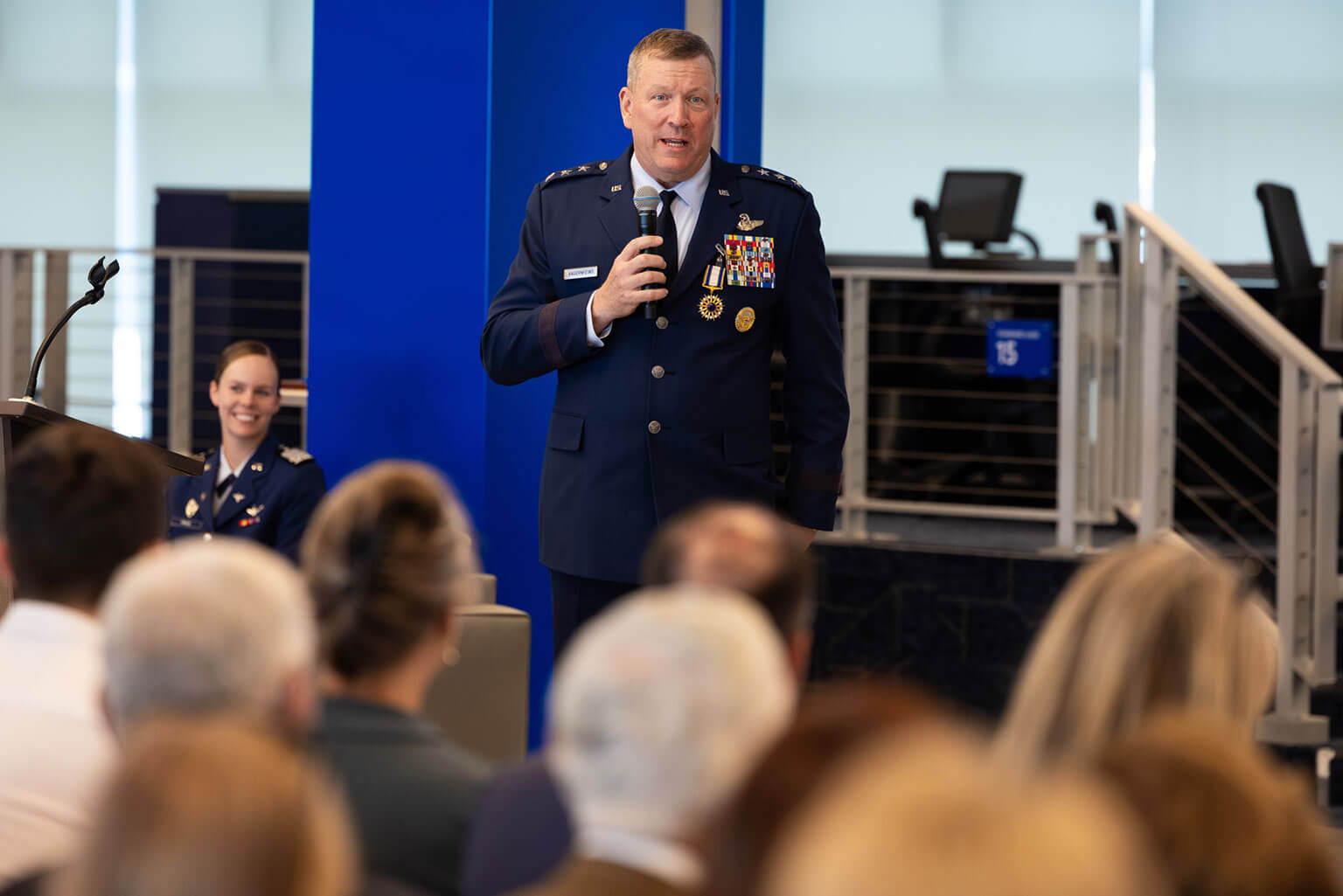
Following a morning change of command ceremony, Lt. Gen. Tony D. Bauernfeind speaks during his retirement ceremony at the U.S. Air Force Academy, Colo., Aug. 7, 2026. His final address centered on the need for the next generation of warfighters to be mentally, physically, and spiritually prepared for their service.
From Cadet to Air Commando
When it came time to apply to college, Bauernfeind was choosing between schools like the Naval Academy, the Air Force Academy and North Carolina State.
As his father had served 20 years as an enlisted Airman, he said, “Well, I’ll try the Air Force Academy… I really didn’t know what it was. I thought I’d get a degree, do five years, and go get a job. Because it was ‘free’.”
On the Terrazzo, that calculus changed.
“I found a family. I found a goal. I found a focus. And it was really my first soaring flight that I felt, ‘Oh my gosh, I love aviation,'” he said. By his junior-year commitment, five years had become a vision for a 20-year career. “I knew I wanted to fly and I wanted to be a part of the Air Force for my career.”
He graduated into a unique moment. After Desert Storm, the Air Force entered the “peace dividend” drawdown—from nearly 700,000 Airmen toward roughly half that size. For the Class of 1991, the guidance was direct: if you were pilot-qualified, you took your slot or reported to the commandant to get your slot. The challenge wasn’t earning wings; it was what came after.
There simply weren’t aircraft waiting for everyone who earned them. Many would be “banked”—winged, then spending three to four years in another assignment until a cockpit opened. In his year, fighters and bombers weren’t offered at drop. The board was largely C-141s, KC-135s, First Assignment Instructor Pilot slots and, for the first time in many years, MC-130E Combat Talons, as AFSOC opened cockpits.
“I had no clue what an MC-130E was. Nowhere at the Academy did they ever talk about special operations,” he said. “But I saw Okinawa, Japan. I thought, ‘Okinawa needs a second lieutenant.’”
Warrior-Leader and Air Commando
He arrived at the 1st Special Operations Squadron at Kadena with a whopping 200 flight hours. His first nine-person Combat Talon crew—two pilots, a flight engineer, two navigators, two loadmasters, a radio operator and an electronic warfare officer—averaged several thousand hours, even counting his 200, a measure of the experience in the unit at the time.
“You did not go to special operations if you weren’t 100% focused on the mission. That was just the culture,” he said.
That crew ethos drove both innovation and accountability, especially for tactics and standards.
As an example, one of his early units was tasked to mission plan penetrating enemy airspace. Planners determined the air defense system was so dense they would have only a three-minute window, but the ground force required mass. They couldn’t get a traditional formation tight enough to work. “What if we could tighten up the formation so much that we start looking like one radar cell?” they mused.
So, they trained to fly fingertip, low-level, at night, in weather, 250 feet off the deck—just feet off each other’s wings—with joint teammates in the back ready execute their follow-on mission, validating the tactics, and solving a problem no one thought possible.
Other days showed the improvisational side of Air Commandos. As a captain supporting SEAL teams at Guam, he got a call on a day off that an American family was lost at sea in a small boat in Micronesia, asking if he could take on a search and rescue mission. His boss told him to give it a go.
After several hours of searching, his crew spotted the boat beached on a distant island. The loadmasters and radio operator rigged a solution, ripping the parachute off a training bundle to airdrop an emergency radio, water and the raft, and called the Coast Guard to the location.
On another mission supporting counter-narcotics contingency operations in South America, his crew faced an in-flight emergency involving the loss of flight controls that required the entire team to work the problem innovate together, to include using a 25K pound tie down strap to secure the yoke and shifting 30K pounds of cargo, in flight, to adjust the CG, and safely recover the aircraft to a divert base.
Those missions, he said, taught him that standards, innovation and trust are inseparable, and that the mission is only accomplished by the power of teamwork and incredible aircrew.
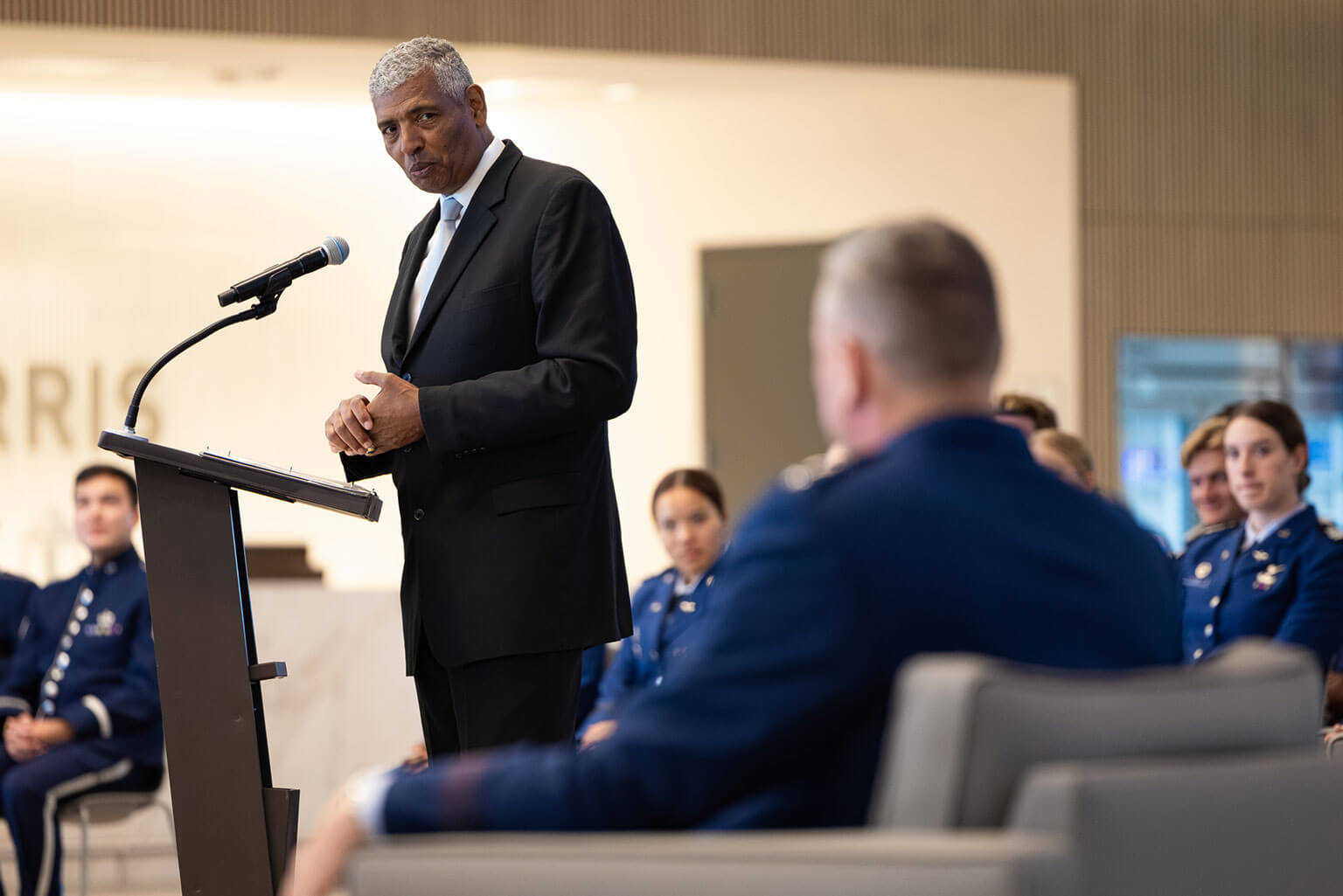
Retired U.S. Army Gen. Vincent K. Brooks, left, speaks about Lt. Gen. Tony D. Bauernfeind during Bauernfeind’s retirement ceremony at the U.S. Air Force Academy, Colo., Aug. 7, 2026. Gen. Brooks described Lt. Gen. Bauernfeind as a deeply experienced combat leader and air commando who was consistently chosen for the hardest, high-risk assignments.
A Change Agent and Transformational Leader
Across commands, Bauernfeind became known as the a leader you call when a unit needs to rebuild, reimagine, or create from scratch—and one who would consistently take the hard right over the easy wrong.
He has described himself as a change agent put in place for transformation— whether it was reversing losses in a special operations unit, bringing quality of life and new combat capabilities to the 27th Special Operations Wing at Cannon, standing up the Air Component for the first Special Operations Joint Task Force in Afghanistan at Admiral McRaven’s request, or returning the Academy to its foundational warfighting purpose.
Early as a squadron director of operations, he learned the formula: find your champions for change fast, identify your barriers fast, and then move out.
“You have to find the people who want to make it better and empower them,” he said. “And you have to figure out who is going to get in the way and give them a chance to better understand the vision—either bring them along or help them find a different journey.”
That pattern repeated at every level. At the 27th Special Operations Wing at Cannon—a relatively remote assignment that demanded a focus on families and infrastructure as much as combat—it meant rebuilding quality of life while simultaneously driving new combat capabilities. That included focusing on building the closest Starbucks in over a hundred miles at the same time fielding the Air Force’s only expeditionary MQ-9 capability to support global rapid response.
At Air Force Special Operations Command, building off of past commander’s visions, it meant making the hard force-structure calls for the future fight—retiring the MC-130H, transitioning to the MC-130J, restructuring five wings, and delivering developing capability at the speed the joint user needed, such as the OA-1K Skyraider II. As well as increasing automated capabilities, like taking the U-28 Draco from concept to first combat sortie in 11 months.
He acknowledged organizations need different leaders at different times…people focused, mission focused, change agents. He recognized he has had incredible teammates, leaders, and mentors over the years that taught him the many tools of command and gave him necessary feedback when he made errors. He learned that while difficult, he was comfortable leading change.
“I’m comfortable with my stripes,” he said. “I’m the guy you bring in when you need change. There’s a different leader you need for sustainment. I’m comfortable with who I am.”
“Mission First, People Always”
The culture he described in his first squadron was uncompromising about the mission. Command taught him the other half.
It’s a lesson he said took him time to learn. When asked now what the most important trait for the next generation of U.S. Air Force and U.S. Space Force leaders is—mission focus or taking care of people—his answer is both. “You cannot be so focused on mission accomplishment that you eclipse your responsibility to care for people,” he said.
Early as a squadron commander, he learned started a practice from other units that had experienced loss that endured the rest of his career: before deployments and high-stakes missions, he had Airmen place a sealed envelope in the commander’s safe with the “hard dining-room-table conversations that go beyond emergency data”—who should care for their kids, what to tell their family, should their worst nightmare become real. It was a lesson that cemented to him the dual responsibility of command: People AND Mission.
“Unfortunately, I had to open that safe,” he said.
That duality—of experiencing the highest highs of mission success and the hardest losses of teammates within days of each other—is the reality of that responsibility. In 2012, as a group commander, he deployed within an hour’s notice for a successful hostage rescue mission and watched the rescue unfold on the first high-definition MQ-9 feed. Two and a half weeks later, one of his U-28 crews, Ratchet 33, that had been overhead for that rescue was lost. He shared how difficult it was to unpack that situation.
As commander of Air Force Special Operations Command, that responsibility scaled. He and his team, led the command through the 2023 CV-22 mishap off Japan, call sign Gundam 22, that claimed eight Airmen, and through the off-duty death of Senior Airman Roger Fortson in Florida.
For Gundam, his team supported the grieving families living in Japan and throughout the United States, to include being there for their dignified transfers and funerals. While devastating, the command had faced training and combat losses in the past and knew how to support the families, honor and remember their lost, and move forward.
The loss of Fortson brought a different kind of grief—an Airman lost not downrange, not to a training accident, but in their home. Airman Fortson’s death devastated the Hurlburt Field community and others. In sensing sessions that followed, a captain put words to what many were feeling: “We all signed up to defend our country and potentially die for our country in a faraway land, not to die for our country in our own homes.”
It’s a weight he said he carried into every decision after—that mission first and people always are not competing priorities, but the same one.
Returning Home: Restoring the Warrior Ethos
When Department of the Air Force leaders Secretary Frank Kendall, Gen. David Allvin and Gen. Chance Saltzman selected Lt. Gen. Bauernfeind as Superintendent, the mission was clear: restore the warrior ethos and return to standards.
He spent the last two years reorienting the institution to its foundational warfighting purpose. The entire Academy team embraced the call to harmonize the military, academic and athletic mission sets and renew emphasis on standards and accountability.
To ensure graduates are prepared for modern conflict, military training was fundamentally restructured to prioritize warfighter readiness and lethality. This was operationalized through a four-class leadership development system that instills progressive leadership and is tested under realistic, high-pressure conditions during events like the Spring Culminating Exercise (CULEX).
His priorities mirrored the Academy’s three mission sets: forging warfighters to win, inspiring leaders of character and quality, and motivating critical thinkers to adapt.
“You looked at our young leaders and said: we’re going to train you to fight, and we’re going to train you to win,” said Air Force Chief of Staff Gen. Ken Wilsbach. “You fought to modernize the curriculum, instill character, and build fitness to ensure that every cadet who walks across this stage is ready to lead a combat-effective unit on day one.”
Reflecting on his time at the Academy, Lt. Gen. Bauernfeind shared, “We are going in the right direction. We’ve got amazing permanent party and faculty, these cadets are absolutely incredible, and they want to take on more. At the end of the day, it’s just going to take necessary sets and reps to be successful.”
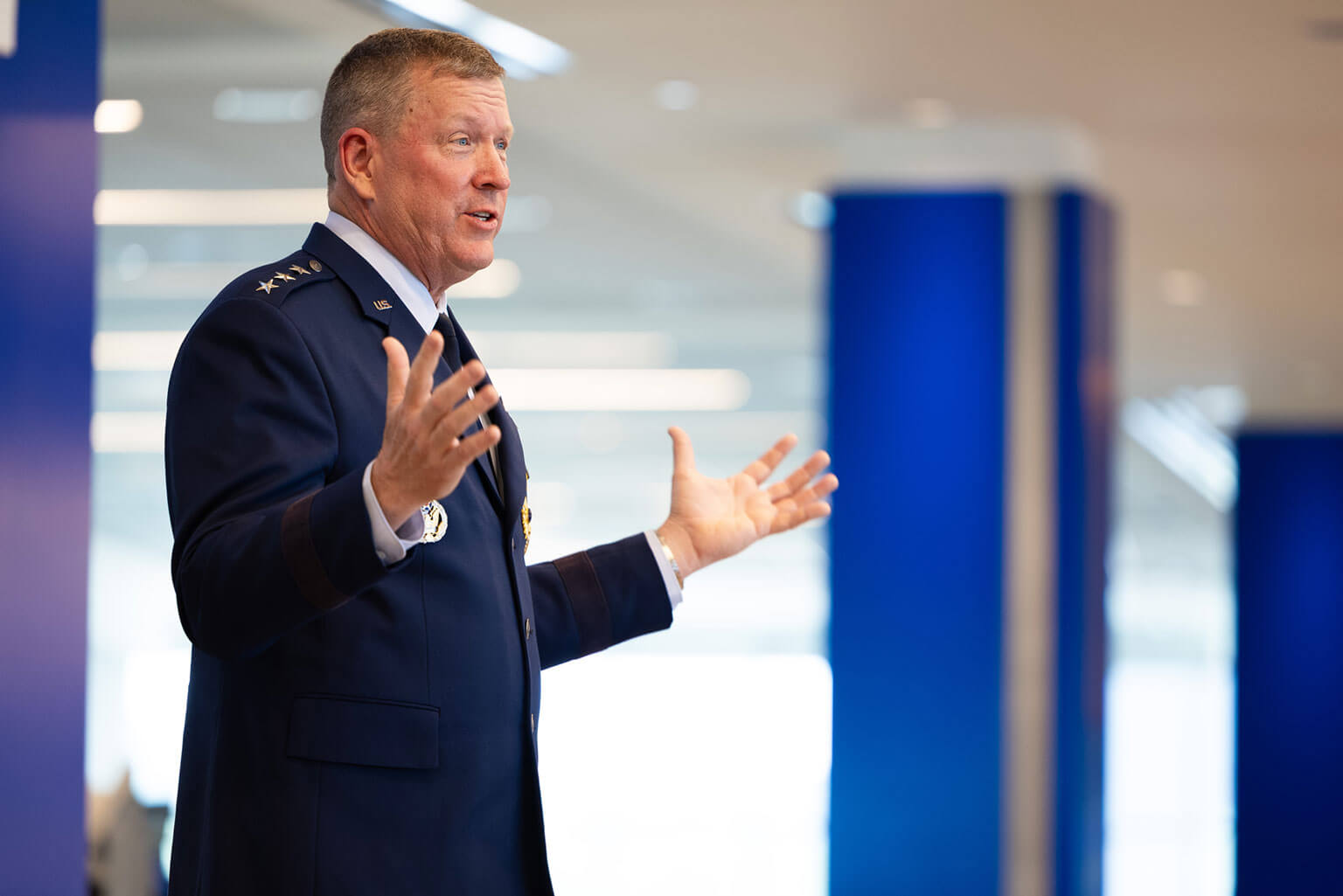
Retired Lt. Gen. Tony D. Bauernfeind speaks to attendees during his retirement ceremony at the U.S. Air Force Academy, Colo., on Aug. 7, 2026. He reminded the next generation of warfighters that they have chosen a path of service and sacrifice and must hold themselves to a higher standard.
A Family Business
Behind every assignment was a family’s service and sacrifice.
Lt. Gen. Bauernfeind credits his wife, Mrs. Tricia Bauernfeind, as the foundation of his career—his teammate since he was a young captain who cared for him and their son and made sure they were always prepared, while also building spouse programs, pre-deployment training and the networks of support that sustain other families through combat and change.
“None of this would have been possible—or worth it—without Tricia,” he said. “I could not have gotten past year four without her. It’s true what they say: ‘you recruit the individual, you retain the family.’”
Their son, who grew up in the Air Commando community, stood alongside them and was recognized throughout the ceremony.
The Long Blue Line
His final address was reserved for the next generation of warfighters.
“Be proud of your institution, support your institution, and be there to support the amazing 4,000 young Americans on the Terrazzo today.”
And to the Airmen, Guardians and Air Commandos he was privileged to lead: “Our job is to always be ready—mentally ready, physically ready, family ready, spiritually ready that when the nation calls, we must always make sure our blade is sharp, and that we’re ready to take the fight forward.”
In his final remarks as Superintendent, he closed where he started.
To the Long Blue Line, his message was direct: “You have chosen a path of service and sacrifice. You have chosen to hold yourselves to a higher standard. Never forget the magnitude of what you are preparing for.”
“The nation needs you. The world needs you. Keep pushing, keep innovating, and continue to take care of one another. I am incredibly proud of you.