Academy Coach Taylor Lorbiecki Takes to the Skies to Better Prepare Future Aviators
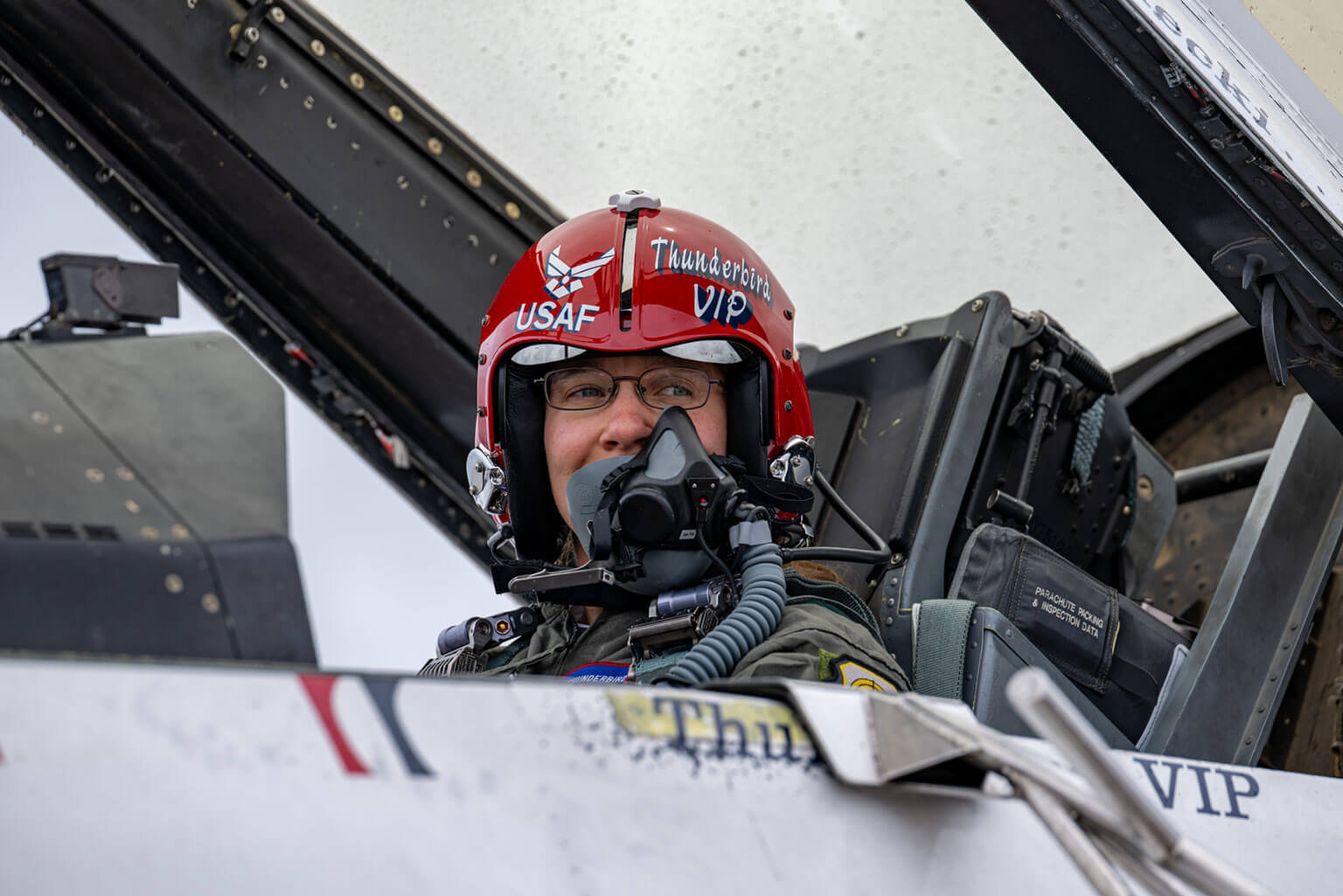
Taylor Lorbiecki sits in the cockpit of a U.S. Air Force Thunderbird F-16 Fighting Falcon before taking off for an orientation flight over Colorado Springs, Colorado, May 27, 2026. The flight honored Lorbiecki, the Academy’s Academic Year 2025-2026 Civilian Instructor of the Year, whose work supports cadets across the Academy. Lorbiecki led the development of the Academy’s Rated Physical Readiness capstone course to build the mental, physical, nutritional, and recovery capabilities required for rated assignments. (U.S. Air Force photo by Tiana Williams)
U.S. Air Force Academy Strategic Communications
U.S. AIR FORCE ACADEMY, Colo. – Taylor Lorbiecki, a U.S. Air Force Academy Advanced Instructor of Physical Education and Assistant Strength and Conditioning Coach, traded her spot on the physical training fields for the backseat of an F-16 Fighting Falcon.
Selected for the opportunity as the Academy’s Civilian Instructor of the Year, Lorbiecki flew with the U.S. Air Force Air Demonstration Squadron – Thunderbirds – May 27, 2026. The flight provided an opportunity to experience the physical and cognitive demands placed on operational aviators, offering valuable insight she can apply to cadet development programs focused on physical readiness and long-term performance.
“To forge the next generation of warfighters, our faculty and staff must deeply understand the operational environment our graduates will face,” said Lt. Gen. Tony D. Bauernfeind, U.S. Air Force Academy Superintendent. “I want to congratulate Coach Lorbiecki on her well-deserved recognition as Civilian Instructor of the Year, and commend the incredible hard work she and our entire Athletic Department put in every day. Together, they are ensuring our cadets graduate fully prepared to lead and fight in the most demanding operational domains.”
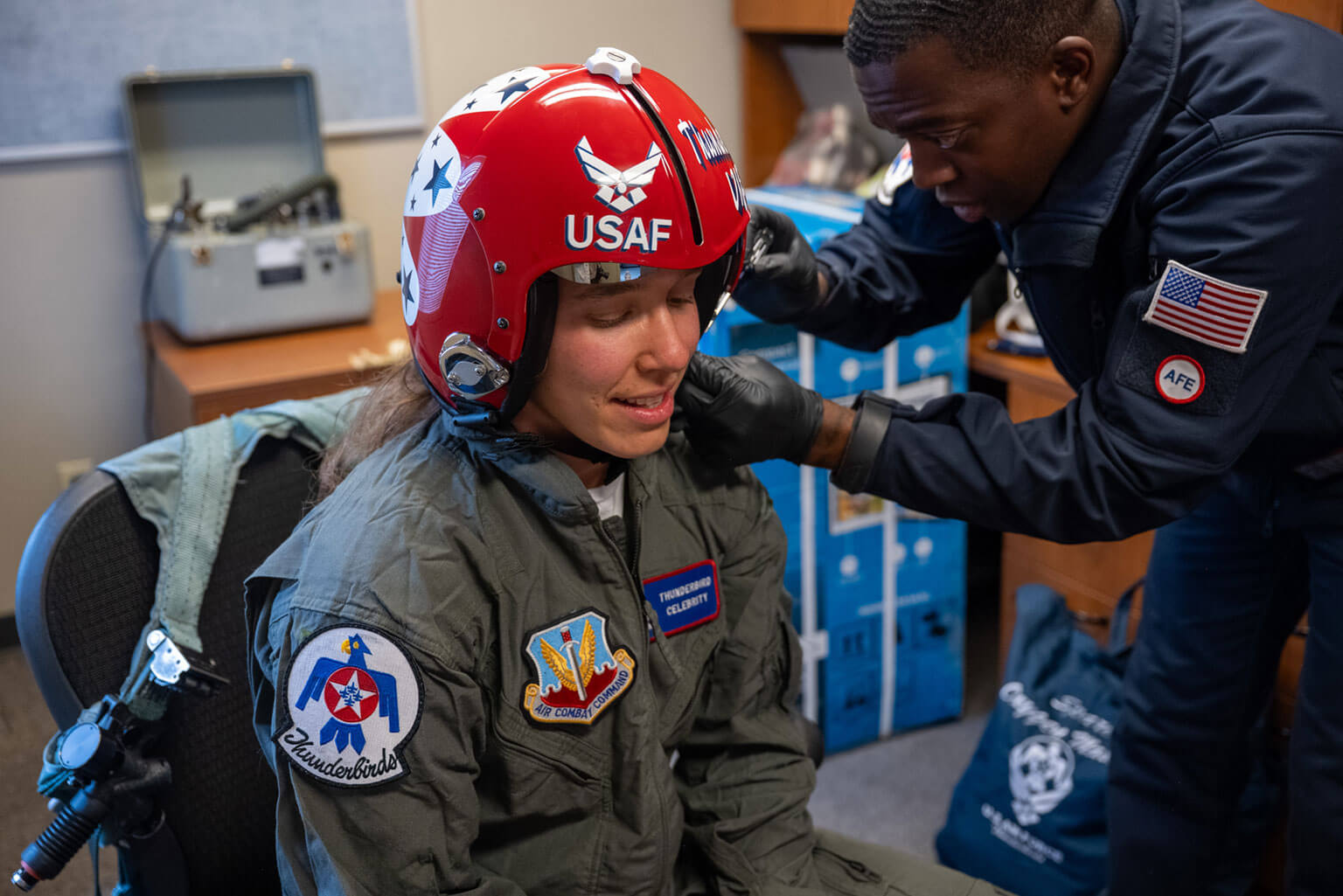
Taylor Lorbiecki, a U.S. Air Force Academy assistant strength and conditioning coach, is fitted for flight gear prior to her orientation flight with the U.S. Air Force Thunderbirds at Peterson Space Force Base, Colorado, May 27, 2026. The flight honored Lorbiecki, the Academy’s Academic Year 2025-2026 Civilian Instructor of the Year, whose work supports cadets across the Academy. She led the development of the Academy’s Rated Physical Readiness capstone course to build the mental, physical, nutritional, and recovery capabilities required for rated assignments. (U.S. Air Force photo by Tiana Williams)
Rated physical readiness
The flight offered a firsthand look at the physical effects of high-performance aviation and aerial maneuvers, including sustained G-forces, rapid decision-making and the integration of physical and mental performance under pressure.
As the Academy directed the increased number of mandatory warfighting physical education courses like Combatives II and Advanced Water Survival, Lorbiecki led the development of the Academy’s Rated Physical Readiness capstone course to build the mental, physical, nutritional, and recovery capabilities required for rated assignments, which encompass operational flying career fields such as pilots, combat systems officers, air battle managers, and remotely piloted aircraft pilots.
“Pulling Gs is unlike any physical stress we can replicate in a traditional training environment,” Lorbiecki said. “It is a profoundly unique kinetic experience where physical, cognitive, and physiological demands are compressed into a single moment. I expected intense physical forces, but what surprised me was how much the mental performance component influenced my ability to successfully execute each maneuver.”
The flight connected her directly to the outcome of her work, as currently nine of the 12 Thunderbird officers are Academy graduates. This allowed Lorbiecki to fly with the type of aviator she designed her Rated Physical Readiness capstone course to prepare.
“Rated Physical Readiness has become the catalyst for a broader evolution in how we approach the physical mission across the 47‑month cadet experience,” Lorbiecki explained. “Our charge is to strategically and systematically develop the human weapon system from I‑Day to graduation.”
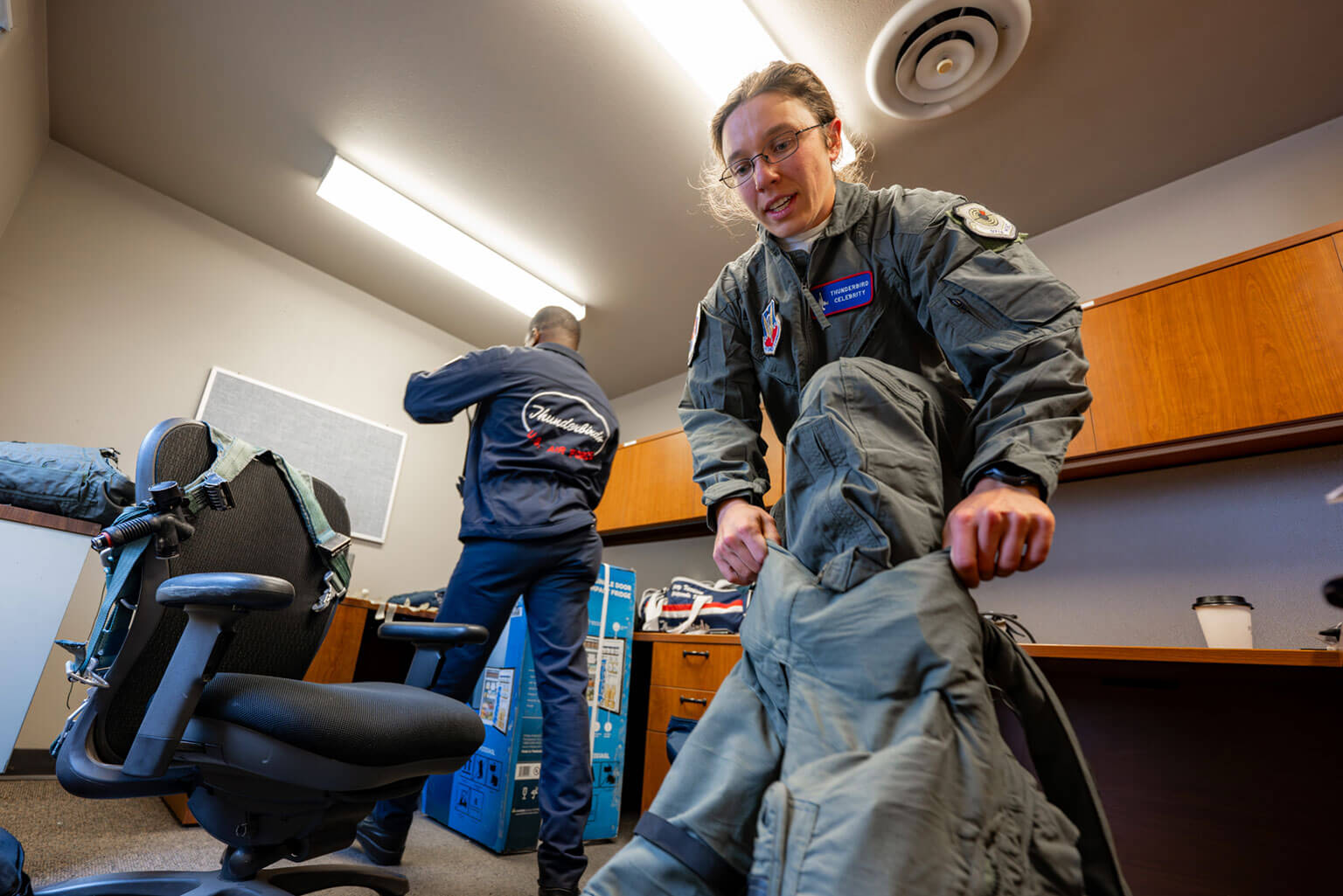
Taylor Lorbiecki, a U.S. Air Force Academy Advanced Instructor of Physical Education and Assistant Strength and Conditioning Coach, puts on flight gear prior to her orientation flight with the U.S. Air Force Thunderbirds at Peterson Space Force Base, Colorado, May 27, 2026. Over the past few years, Lorbiecki has modernized conditioning programs across the cadet wing, contributing to a 76.5 percent reduction in bone stress injuries during Basic Cadet Training. She led the development of the Academy’s Rated Physical Readiness capstone course to build the mental, physical, nutritional, and recovery capabilities required for rated assignments. (U.S. Air Force photo by Tiana Williams)
Building foundational readiness
That effort extends far beyond preparation for rated career fields. Lorbiecki has helped reshape how cadets build physical capability throughout their time at the Academy by aligning programs across Basic Cadet Training, squadron fitness initiatives, physical education courses, military training exercises and intercollegiate athletics.
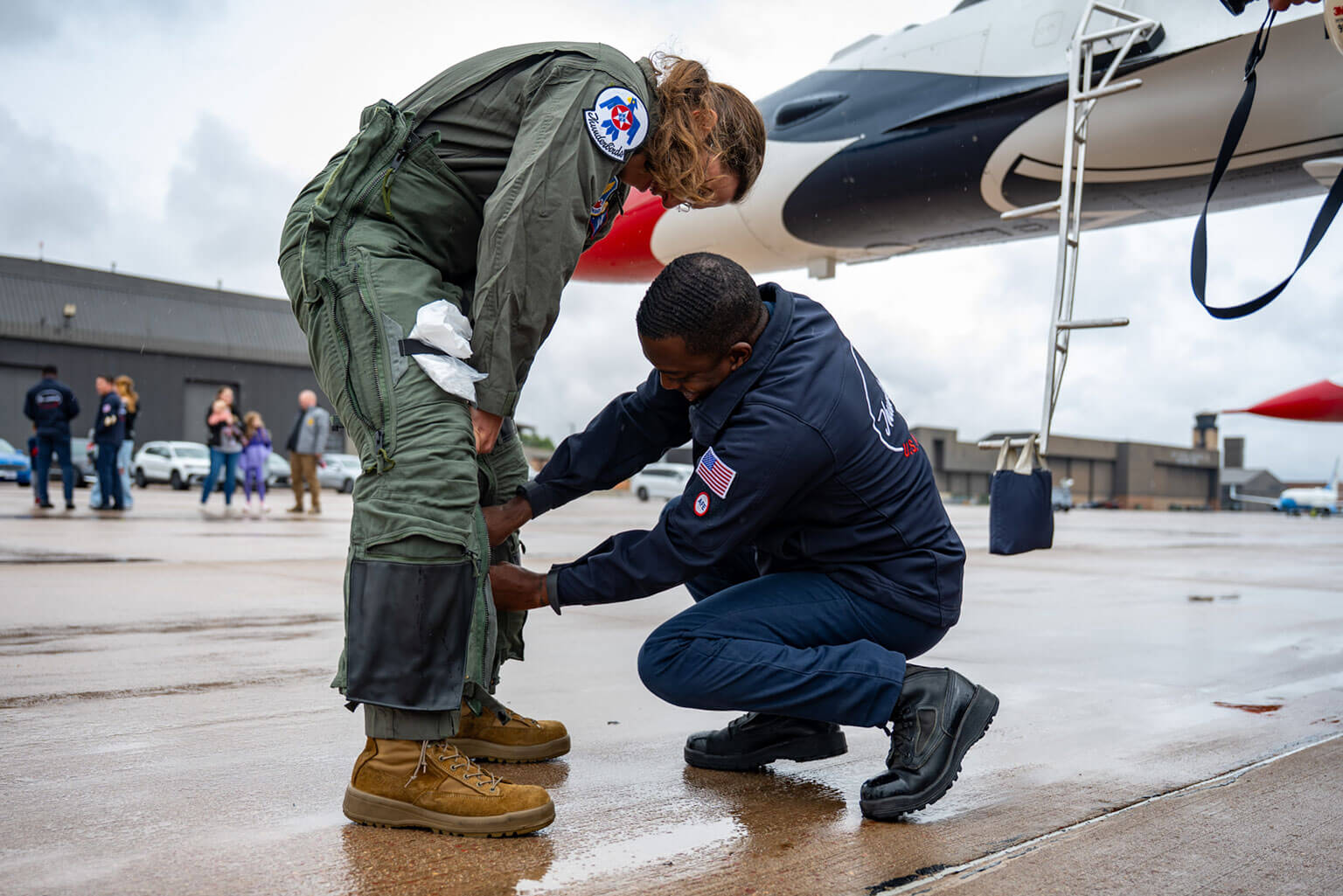
Taylor Lorbiecki, a U.S. Air Force Academy assistant strength and conditioning coach, puts on flight gear prior to her orientation flight with the U.S. Air Force Thunderbirds at Peterson Space Force Base, Colorado, May 27, 2026. The flight honored Lorbiecki, the Academy’s Academic Year 2025-2026 Civilian Instructor of the Semester, whose work supports cadets across the Academy. She led the development of the Academy’s Rated Physical Readiness capstone course to build the mental, physical, nutritional, and recovery capabilities required for rated assignments. (U.S. Air Force photo by Tiana Williams)
“This experience reinforces the strategic importance of developing every cadet as a high-performing human being, regardless of future AFSC. It highlights the necessity of a cohesive, systematic, and institution‑wide approach to the physical mission; one that connects physical education and physical training across all 47 months,” she said. “It also validated the foundational role of daily physical preparation. High performance is truly built through disciplined, consistent, and intentional work overtime.”
The results of that approach have been measurable. Between 2022 and 2024, Academy programs contributed to a 76.5% reduction in bone stress injuries. Physical training initiatives also helped recent classes achieve 10% to 15% improvements on the Physical Fitness Test, with this last semester’s PFT ranking as the highest average score in over 10 years.
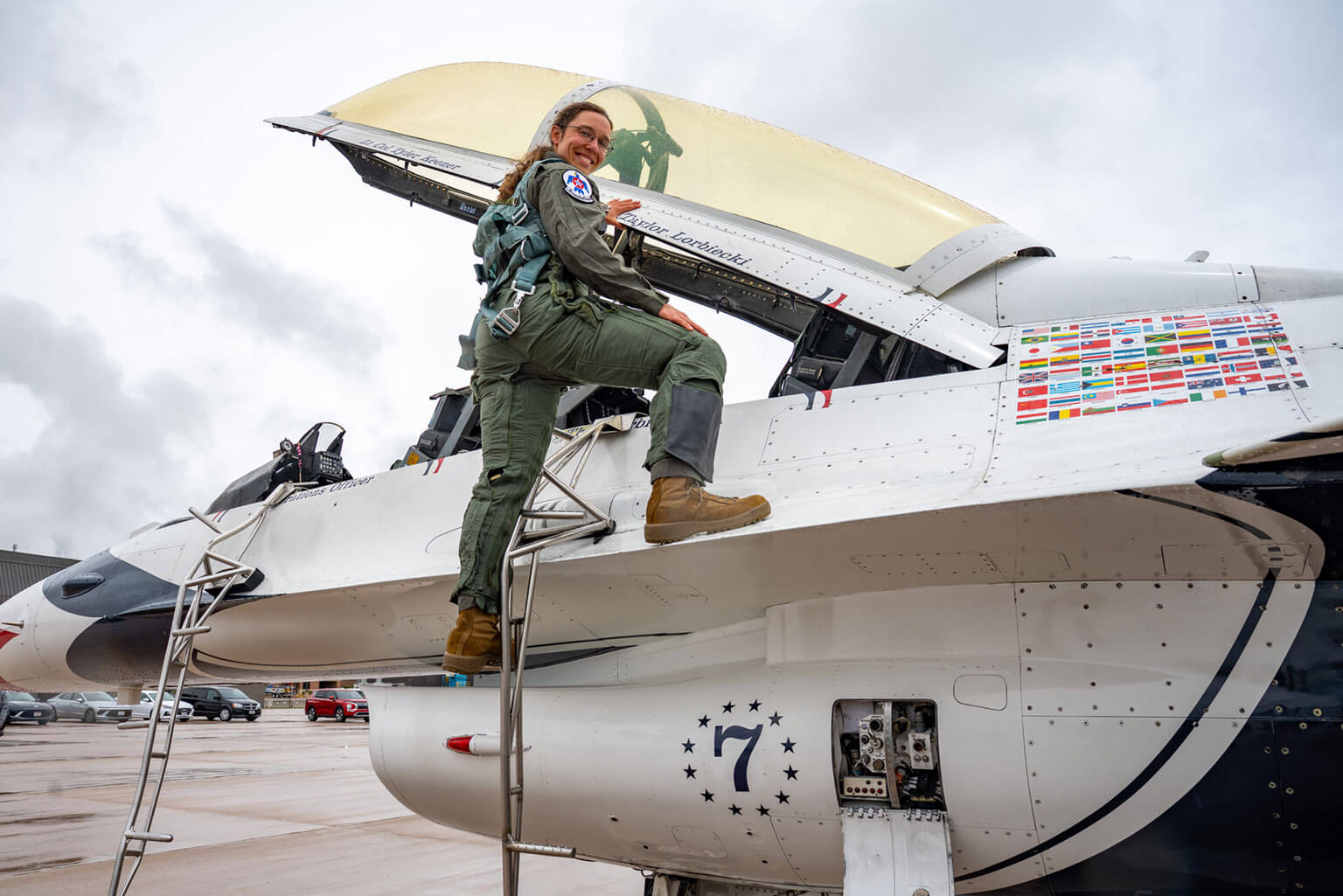
Taylor Lorbiecki, a U.S. Air Force Academy assistant strength and conditioning coach, poses for a photo on an F-16 Fighting Falcon at Peterson Space Force Base, Colorado, May 27, 2026. Over the past few years, Lorbiecki led the development of the Academy’s Rated Physical Readiness capstone course and modernized conditioning programs across the cadet wing, contributing to a 76.5 percent reduction in bone stress injuries during Basic Cadet Training. (U.S. Air Force photo by Tiana Williams)
Ready to lead on Day One
In addition to foundational fitness development, Lorbiecki designs and executes tactical physical scenarios for major cadet training events, including the annual Validation Exercise, VALEX, and the Superintendent’s Challenge. Those experiences help cadets apply physical readiness in realistic, mission-focused environments.
Reflecting on the flight’s impact, she shared a message with her Athletic Department teammates: “We are not just educating and training cadets; we are developing the human weapon system for our United States Air Force and Space Force.”
Following her Thunderbird flight, Lorbiecki returned to her daily role with a perspective on aerial demands. Her ongoing work ensures the Academy continues to produce physically prepared leaders, ready to operate in any domain.
“Our country is counting on you to deliver; to be elite and to be prepared for the extraordinary demands required to fight and win our nation’s wars,” Lorbiecki said in a final message to Academy cadets.
Learn more about the Academy’s athletics program.