Nuclear Weapons and Strategy Minor builds strategic deterrence expertise

(From left to right) Cadets 1st Class Andrew Katz, Joseph Phetmixay, Maria Davison and Lilliana Turra pose in front of a government building in Helsinki, Finland, June 18, 2025. The cadets interviewed officials from Finland’s Ministry of Foreign Affairs about Finland’s internal posture and nuclear deterrence policy. (Photo by Dr. Shane Smith)
By SSgt Michael Ward
U.S. Air Force Academy Strategic Communications
U.S. AIR FORCE ACADEMY, Colo. – As global deterrence dynamics continue to evolve, the Air Force is renewing its focus on strategic readiness. The Nuclear Weapons and Strategy minor at the U.S. Air Force Academy helps cadets develop technical and strategic expertise. It prepares future officers to support the nation’s nuclear enterprise and strategic deterrence mission. Designed for cadets from all academic majors, the interdisciplinary program provides foundational knowledge across nuclear science, engineering, policy and strategy. These disciplines are essential to sustain credible deterrence and ensure future officers are prepared to operate in a complex strategic environment.
“Our curriculum equips cadets with the knowledge, skills and readiness needed to contribute effectively to the nuclear enterprise,” said Lt Col Matthew Recker, director of nuclear science and assistant professor in the Department of Physics and Meteorology. “We use unclassified instruction in nuclear engineering, strategy and policy, then supplement that with classified guest lectures from Department of Energy experts and experiential learning opportunities.”
Recker explained that cadets also engage directly with the operational nuclear enterprise through visits to national laboratories, missile wings and the Nevada National Security Site.
A cross-disciplinary academic foundation
The Nuclear Weapons and Strategy minor integrates technical and policy-focused coursework across multiple academic departments. To earn the minor, cadets complete five core courses totaling 15 semester hours and earn a grade of C or better in each. The curriculum provides foundational knowledge in nuclear science, weapons engineering, effects and policy, while allowing cadets to tailor their experience through academic focus, research and collaboration with faculty and peers.
Coursework includes Principles of Nuclear Science, Nuclear Weapons Engineering, Nuclear Weapons Effects and Nuclear Weapons Policy and Strategy, along with an option course, such as American Foreign and National Security Policy.
The minor is open to cadets from all majors. Program requirements limit enrollment to a maximum of three courses from any single department, reinforcing the interdisciplinary focus.
According to Recker, this approach reflects the realities of today’s nuclear challenges.
“Nuclear engineering is essential to understand how weapons work and to predict their effects,” Recker said. “But nuclear weapons must also be understood through history and national policy. Their impact extends into deterrence, nonproliferation and mission planning.”
Cadet 1st Class Andrew Katz, a Nuclear Weapons and Strategy minor, learns about the nuclear enterprise, U.S. Air Force Academy, Colo., Jan. 27, 2026. The Nuclear Weapons and Strategy minor provides a pathway for cadets from all majors to build the technical and strategic foundation to lead the U.S. Air Force in the second nuclear age. (U.S. Air Force photo by Trevor Cokley)
Academic relevance and future applications
The Nuclear Weapons and Strategy minor provides cadets with the technical and strategic foundation needed to support the nuclear enterprise after commissioning. Coursework prepares cadets for roles in operations, intelligence and policy while also supporting future education, research and training opportunities within both the Department of War and the Department of Energy.
Cadet 1st Class Andrew Katz said the program has given him a stronger understanding of how technical knowledge applies to real-world nuclear operations.
“As a future pilot, it gives me a better understanding of how airpower fits into the nuclear mission and prepares me to bridge operational flying with strategic-level deterrence work,” Katz said.
Cadets also gain opportunities to apply classroom learning through research and immersive academic programs. Cadet 1st Class Lillianna Turra said her experience in a six-week Cadet Summer Research Program, led by the Institute for National Security Studies and funded by the Defense Threat Reduction Agency’s Wargaming Division, focused on U.S. extended deterrence to NATO significantly shaped her perspective.
Hands-on research and summer programs give cadets a deeper understanding of nuclear strategy and its real-world complexities.
“The research gave me a strong foundation, but the conversations with government officials and think tanks helped me understand the nuance involved in nuclear strategy,” Turra said. “It also taught me lessons in diplomacy and cultural awareness that will be critical as an officer.”

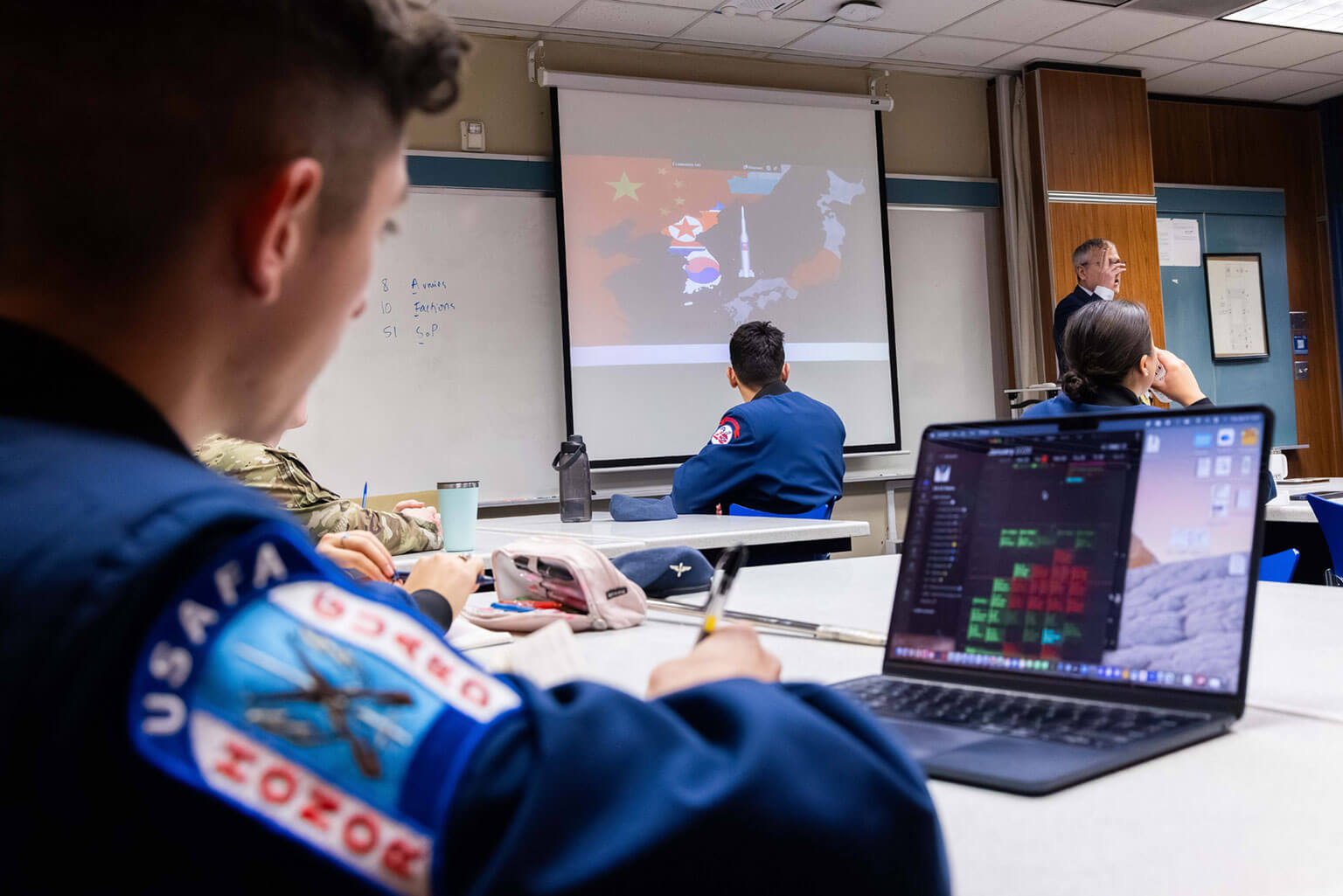
Cadet 1st Class Andrew Katz, a Nuclear Weapons and Strategy minor, engages in classroom discussion, U.S. Air Force Academy, Colo., Jan. 27, 2026. The skills and abilities developed in the Nuclear Weapons and Strategy minor are of high importance to the execution of the Air Force’s nuclear mission, maintenance of the Air Force’s nuclear arsenal, and may be applied in many Air Force career fields. (U.S. Air Force photo by Trevor Cokley)
Preparing future nuclear enterprise leaders
As the global security environment continues to evolve, the Nuclear Weapons and Strategy minor offers a structured academic path for cadets interested in contributing to the nation’s nuclear mission.
The program develops cadets’ understanding of how career fields contribute to deterrence and how daily decisions align with strategic outcomes.
“This minor helps me lead more strategically because it shows how every career field directly or indirectly affects nuclear deterrence,” Katz said. “It helps explain why the mission matters.”
Recker noted the program also provides rare access to classified nuclear education.
“For most cadets, this will be their only opportunity to learn the classified specifics of nuclear weapons unless they enter the missile or nuclear engineering career fields,” he said.
By providing cadets with exposure to the strategic, technical and policy dimensions of nuclear deterrence, the program ensures future Air Force and Space Force leaders are prepared for global security responsibilities.
Learn more about the Institute for National Security Studies and Academy majors and minors.