
Hosmer Visitor Center
Exit 156 off I-25, just before the North Gate entrance.
The Academy’s Hosmer Visitor Center is located just outside the North Gate and serves as the starting point for your visit. Interactive exhibits highlight cadet life, military training, academics and career opportunities in the Air Force and Space Force. Guests can explore class crests, reflect on the core values, watch immersive videos and discover what it means to lead in service to the nation.
The Hosmer Visitor Center is open daily from 9 a.m. to 5 p.m. and closed on Federal holidays, Christmas Eve and New Year’s Eve.

B-52 Display
Immediately after entering the North Gate, you will notice a large aircraft on your left. Turn left to park.
The B-52 Stratofortress has served as the backbone of America’s long-range bomber force for decades. “Diamond Lil” entered service in 1957 and was relocated to the Academy following its retirement in 1983.
Nearby, you’ll also find the Academy Air Warrior Combat Memorial and an HH-3E “Jolly Green” helicopter, added in 2022. The HH-3E honors Air Force combat search and rescue forces whose enduring motto, “That Others May Live,” reflects their commitment to recovering isolated personnel under the most demanding conditions.

Academic Overlook
Continue on North Gate Boulevard (which becomes Academy Drive) and stop at the first overlook on your left for a panoramic view of the academic area.
From here, you’ll see Fairchild Hall, the Academy’s primary academic building. Home to academic departments and research centers, it is where cadets pursue majors spanning engineering, science, the humanities and social sciences while preparing to become officers. Inside, cadets learn in advanced classrooms and laboratories, including the Multi-Domain Laboratory and the Language Learning Center, where they develop the knowledge and skills needed to lead in an increasingly complex world.

Athletic Overlook
Continue along Academy Drive to the second overlook on your left.
Athletics are an essential part of cadet development, building the physical fitness, resilience and teamwork required of future officers. Every cadet competes in either NCAA Division I athletics or intramural sports. The 57 athletic fields below span more than 140 acres, while the Cadet Gymnasium features world-class training facilities, swimming pools, climbing walls and the Performance Science Center, where sports science helps cadets perform at their best.

Planetarium
Continue driving and take your second left into the upper Arnold Hall and Planetarium parking lot. Use 2302 Cadet Drive in your navigation app. The dome-shaped building is the Planetarium.
The Planetarium is a 110-seat immersive theater featuring a state-of-the-art 360-degree digital projection system. It supports cadet education while offering free public shows that explore astronomy, space and aviation. Showtimes are available online, and seating is first-come, first-served. Programs may be canceled without notice due to weather or cadet training.
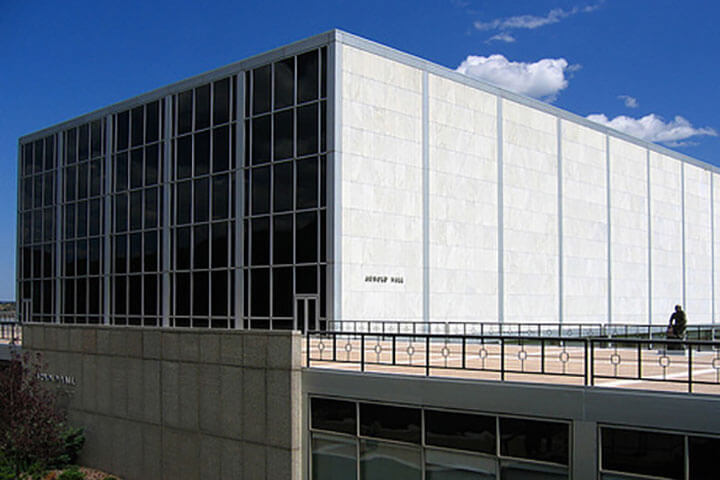
Arnold Hall
Walk from the Planetarium to Arnold Hall, identified by the statue of Gen. Henry H. “Hap” Arnold, the first general of the U.S. Air Force.
Arnold Hall serves as the cadet social center and a gathering place for visitors. Inside, you’ll find a theater, food court and exhibits highlighting the Academy’s heritage, including the Tuskegee Airmen and Academy graduates who became astronauts. It’s also home to the Arnold Hall Ballroom, where cadets celebrate at the annual Ring Dance before entering their final year at the Academy.

Polaris Hall
Walk up the stairs located south of Arnold Hall.
With its distinctive apex pointing toward the North Star, Polaris Hall is home to the Center for Character and Leadership Development. The 43,000-square-foot facility includes collaborative learning spaces, classrooms, offices, a lecture hall and the Honor Board Room, where cadets uphold the Academy’s Honor Code: “We will not lie, steal or cheat, nor tolerate among us anyone who does.”
Polaris Hall is not open to the public.
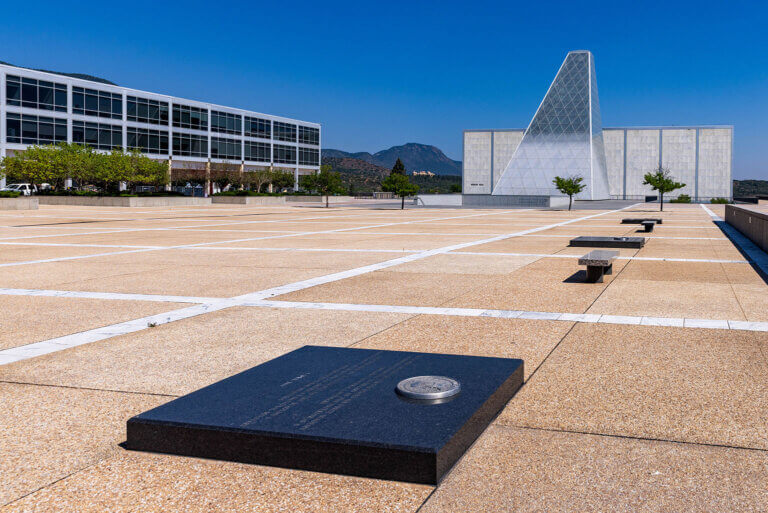
Honor Court
Honor Court is located adjacent to Harmon Hall, the Academy’s administrative headquarters.
Honor Court reflects the Academy’s enduring commitment to integrity and ethical leadership. Nearby, Harmon Hall houses the Office of the Superintendent and is recognized by its distinctive red mosaic wall. At the south end of the court, the Harmon Memorial honors Lt. Gen. Hubert R. Harmon, whose vision helped shape the Academy and its mission to develop leaders of character.

Cadet Noon Meal Formation
The Honor Court overlook provides an expansive view of the Cadet Area and Colorado Springs.
During the academic year, cadet squadrons march across the Terrazzo during the Noon Meal Formation, Monday through Friday at 11:30 a.m., weather permitting. Watching the Cadet Wing move in formation is one of the Academy’s most recognizable traditions and offers a memorable glimpse into daily cadet life.
Schedules are subject to change or cancellation without notice.
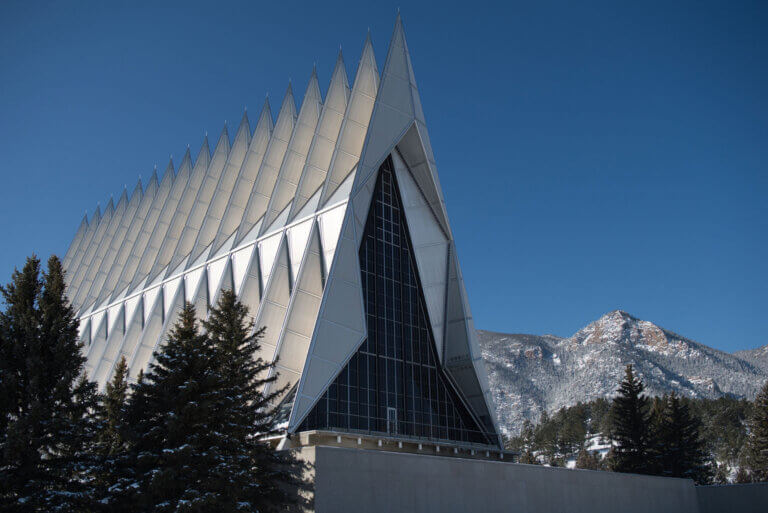
Cadet Chapel
Located at the southeast corner of the Honor Court.
The Cadet Chapel is currently closed for a major restoration project and is expected to reopen in 2028. A climate-controlled enclosure surrounds the building, allowing construction to continue year-round while preserving this National Historic Landmark.
Completed in 1962, the Cadet Chapel is one of the Academy’s most recognizable landmarks. Its 17 aluminum spires rise 150 feet above the Cadet Area, creating an iconic silhouette that has welcomed generations of cadets and visitors. Designed as an all-faith center, the Chapel serves the spiritual needs of the Cadet Wing.

Chapel Trail
If you’d like to stretch your legs, cross the road located behind the Harmon Memorial/Cadet Chapel to access the Chapel Trail.
This paved out-and-back trail extends one-third mile in each direction, offering sweeping views of the Academy and the Front Range, with benches along the route for rest and relaxation. Because of the elevation, visitors are encouraged to take breaks and stay hydrated. Those using mobility devices should be aware that portions of the trail may require additional assistance.

Wecker & Doolittle Halls
Return to your vehicle and use 3115 Academy Drive in your navigation app. Visitor parking is available.
If you see the Pegasus statue, you’ve arrived at Wecker Hall and Doolittle Hall, home to the U.S. Air Force Academy Association & Foundation. Begin your visit by walking the Heritage Trail across Challenge Bridge to the Southeast Asia Pavilion and Memorial Wall, an indoor-outdoor exhibit honoring the service and sacrifice of those who served during the Vietnam War.

Before you leave, stop by the Doolittle Outfitters Gift Shop on the second floor for Academy apparel, gifts and memorabilia. The shop is open Monday through Friday from 7:30 a.m. to 4:30 p.m.

Falcon Stadium
Head back to you vehicle and use 2168 Field House Drive. Visitor parking is available.
At more than 6,600 feet above sea level, Falcon Stadium is one of the highest-elevation Division I football stadiums in the nation. Set against the Front Range of the Rocky Mountains, it provides a spectacular setting for Air Force football, featuring military flyovers, Wings of Blue parachute demonstrations and the Cadet Wing’s traditional march-on.
With seating for nearly 47,000 spectators, the stadium also hosts the Academy’s annual graduation ceremony. Before you leave, stop for a photo with the Belk Falcon Statue, whose 24-foot wingspan has become an iconic landmark.

Airfield Overlook
Continue south past Falcon Stadium as Stadium Boulevard becomes South Gate Boulevard.
On your left, you’ll overlook Davis Airfield and the Academy’s A-10 Thunderbolt II and T-38 Talon static aircraft displays. Pull over to enjoy panoramic views of the airfield and the Front Range, and take advantage of one of the Academy’s most popular photo opportunities.
This is the final stop on the self-guided tour. Continue south on South Gate Boulevard to exit the installation.
Thank you for visiting the Academy, and we hope to welcome you back again soon.