Cadets develop critical thinking skills during engineering lab
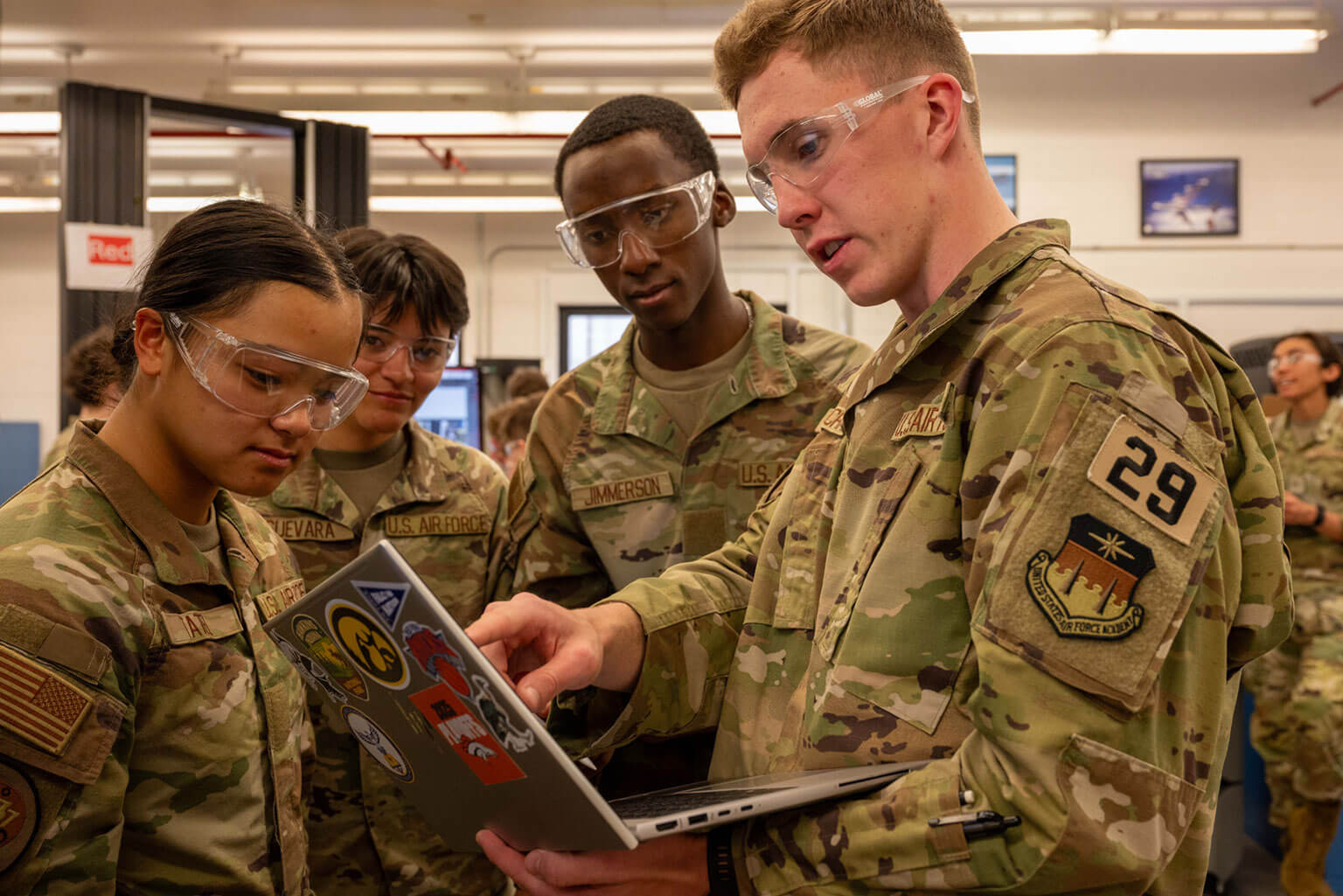
Cadets view a force vs. displacement graph during a Mechanical Engineering 220 class at the U.S. Air Force Academy, Colo., March 18, 2026. During the lab, cadets test, graph, and analyze data to determine if a metal alloy is suitable for a specific design application. (U.S. Air Force photo by Tech. Sgt. Zach Vaughn)
By TSgt Zach Vaughn
U.S. Air Force Academy Strategic Communications
U.S. AIR FORCE ACADEMY, Colo. – Cadets at the U.S. Air Force Academy are honing their critical thinking skills in core classes like Mechanical Engineering 220: Fundamentals of Mechanics.
Throughout the semester, cadets in the Academy’s Mechanical Engineering Department are introduced to fundamental concepts such as forces, moments and truss analysis. These principles of statics and mechanics of materials are then applied to aerospace systems, preparing them for future challenges.
“Regardless of whether a cadet is going to major in some sort of engineering field or not, I think it’s great to build that fundamental understanding,” said Cadet 4th Class Kydan Echard, a civil engineering major from Cadet Squadron 38. “As future officers, we have to have this well-rounded education so any challenges that get thrown at us, we’re able to respond.”
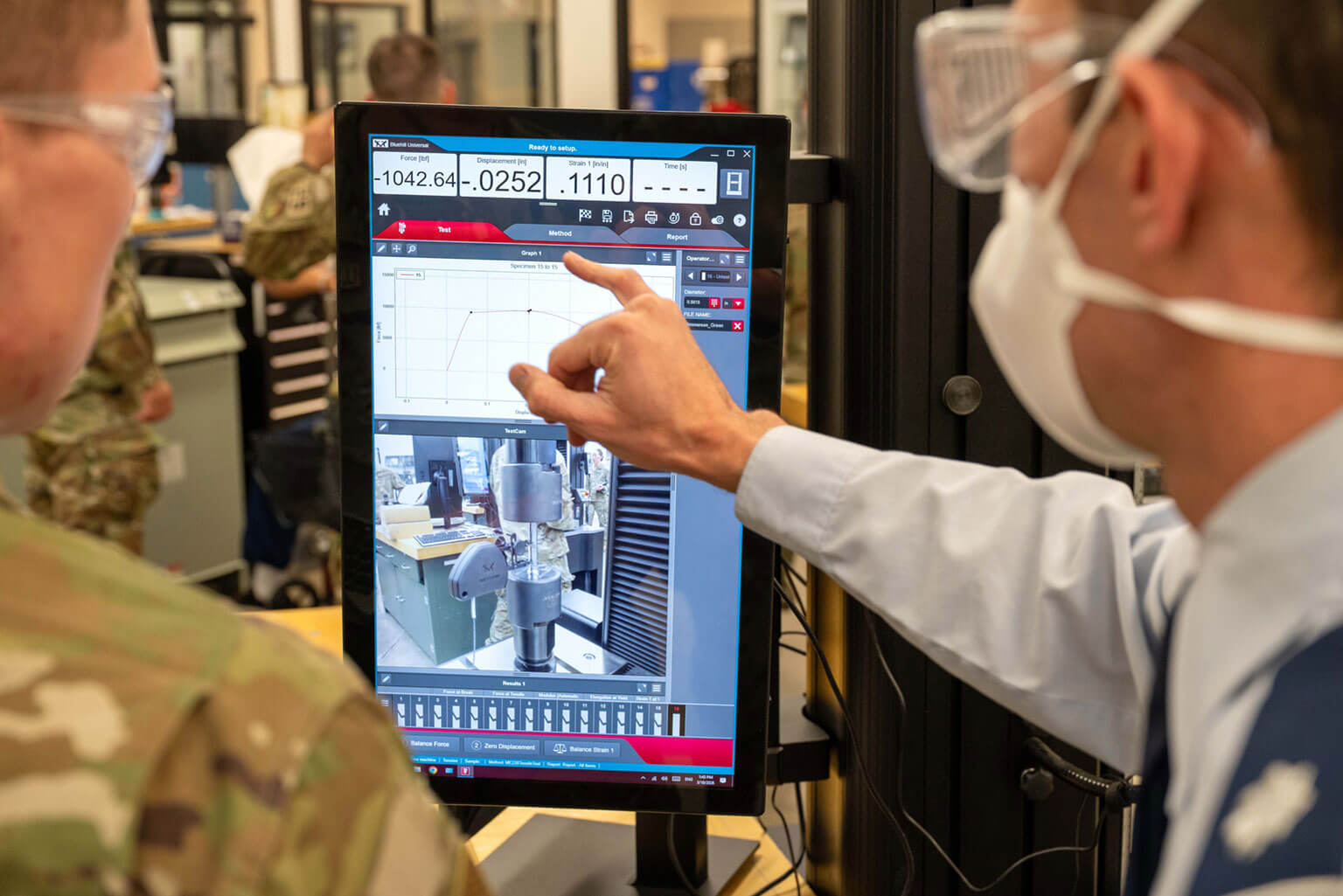
Lt. Col. Matthew Schwaab (right), an assistant professor of mechanical engineering, shows Cadet 4th Class Kydan Echard, a civil engineering major, a force vs. displacement graph during a tensile test at the U.S. Air Force Academy, Colo., March 18, 2026. Cadets use the graph’s stress-strain curve to reveal key material properties during the test. (U.S. Air Force photo by Tech. Sgt. Zach Vaughn)
Material Properties and Behavior
A key part of the course involves learning how material properties affect engineering design. As part of these studies, cadets conduct a tensile test using a hydraulic machine to pull apart a test sample of unknown material. By analyzing the material’s stress, strain, and density, they had to identify the alloy and evaluate its suitability for a project’s design.
“As engineers, we’re creating things where someone’s life could rely on that item or piece of equipment,” Echard said. “For example, on an airplane you don’t want to use a material that will easily snap. So, having a baseline understanding of how those materials function and how they react to certain conditions is very important.”
The lab provides a practical scenario for the scientific principles learned in the classroom.
“We’re taking the fundamental science from physics and giving it an application,” said Lt. Col. Matthew Schwaab, an assistant professor of mechanical engineering. “They’re learning the formulas and calculations that go into predicting the behavior of a structure before we expend the effort to build a prototype and test it operationally.”
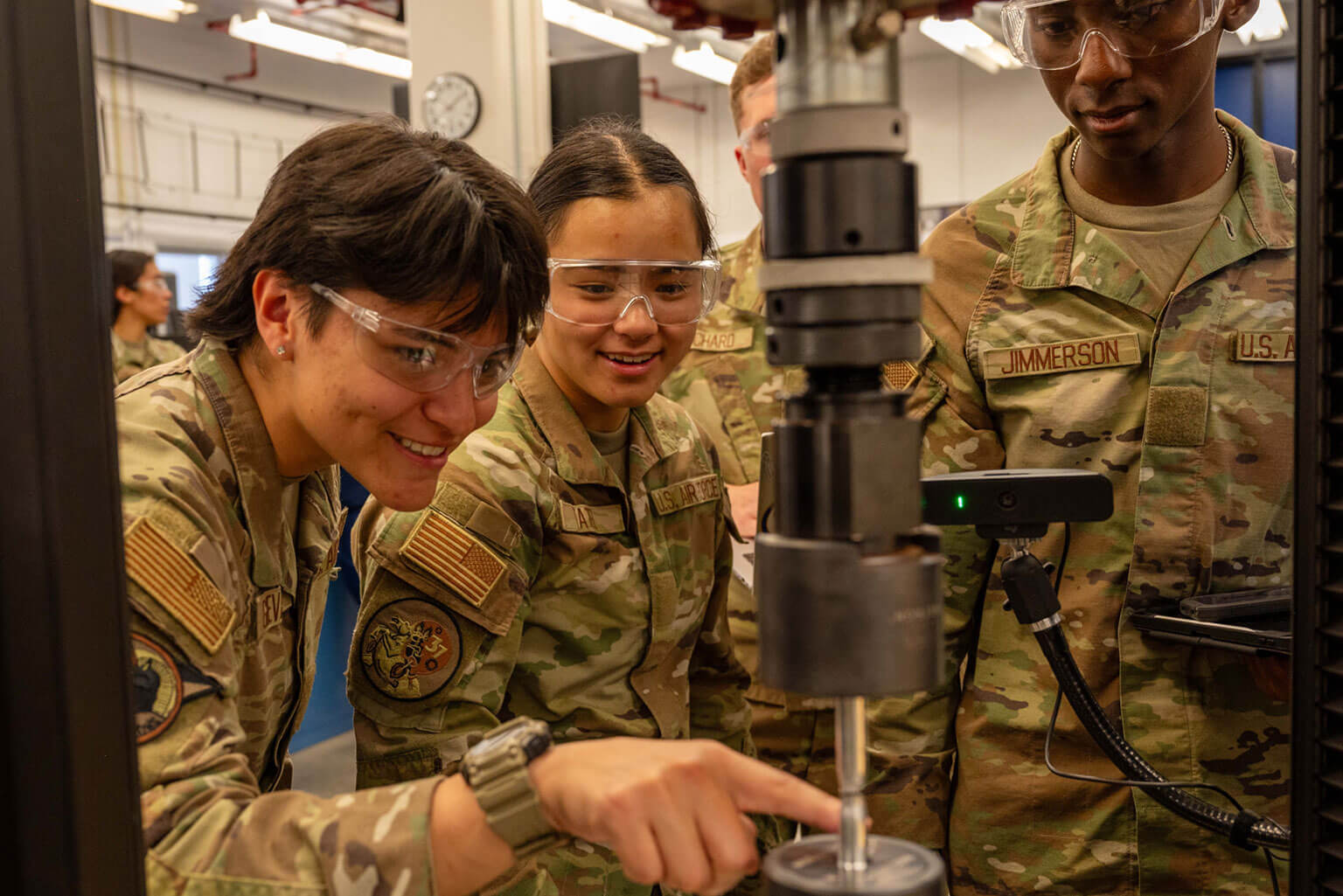
Cadets in the Mechanical Engineering Lab examine a piece of alloy during a tensile test at the U.S. Air Force Academy, Colo., March 18, 2026. As part of the test, cadets analyze the material’s properties to determine its suitability for a project’s design. (U.S. Air Force photo by Tech. Sgt. Zach Vaughn)
Critical Thinkers to Analyze
According to Schwaab, the hands-on experience in the lab is crucial for strengthening the cadets’ leadership foundation and preparing them to be effective officers in the Air Force and Space Force.
“We give them a framework for problem solving,” said Schwaab. “It doesn’t just have to apply to engineering. They can apply it to just about anything.”
Upon graduation, cadets are commissioned as second lieutenants. Schwaab encourages them to remember the lessons learned in their engineering labs throughout their careers.
“Many cadets are striving to be pilots or work in operational fields and whether or not they’re going to major in engineering, I want them to take away the fact that a lot of detailed analysis went into creating their aircraft or rifle or whatever piece of equipment they use,” he said. “They can trust the engineering that went into the design of their equipment but need to understand all structures have operational limits. If those limits are exceeded, things are going to go wrong.”
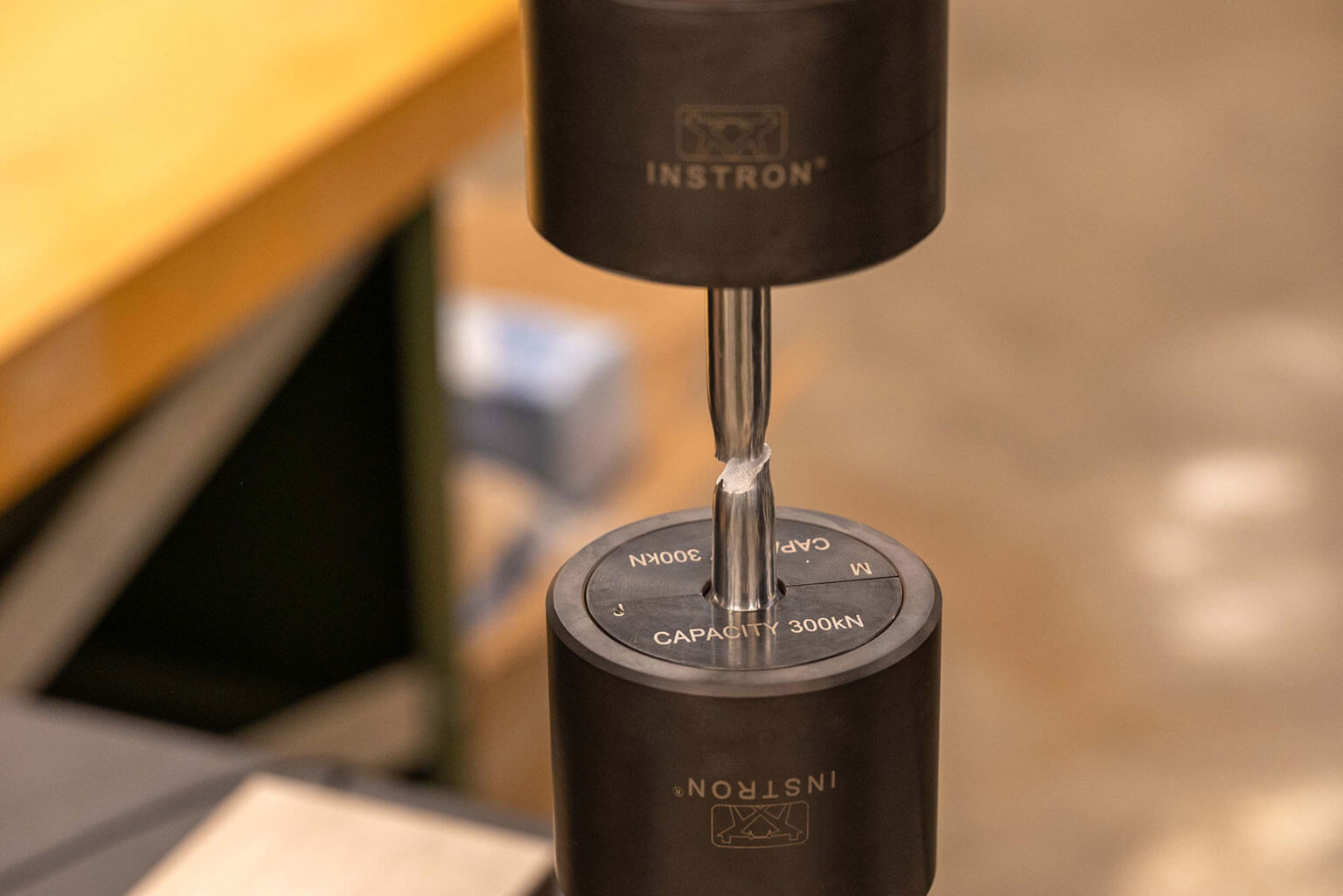
A piece of metal alloy shears under stress during a tensile test at the Mechanical Engineering Department, U.S. Air Force Academy, Colo., March 18, 2026. Cadets use a hydraulic machine to pull apart alloy material to determine if the material is an appropriate choice for a specific design. (U.S. Air Force photo by Tech. Sgt. Zach Vaughn)
Mechanical engineering is a broad, foundational major offered at the Academy, with areas of emphasis that include thermal fluid sciences, design and material science.