Bio
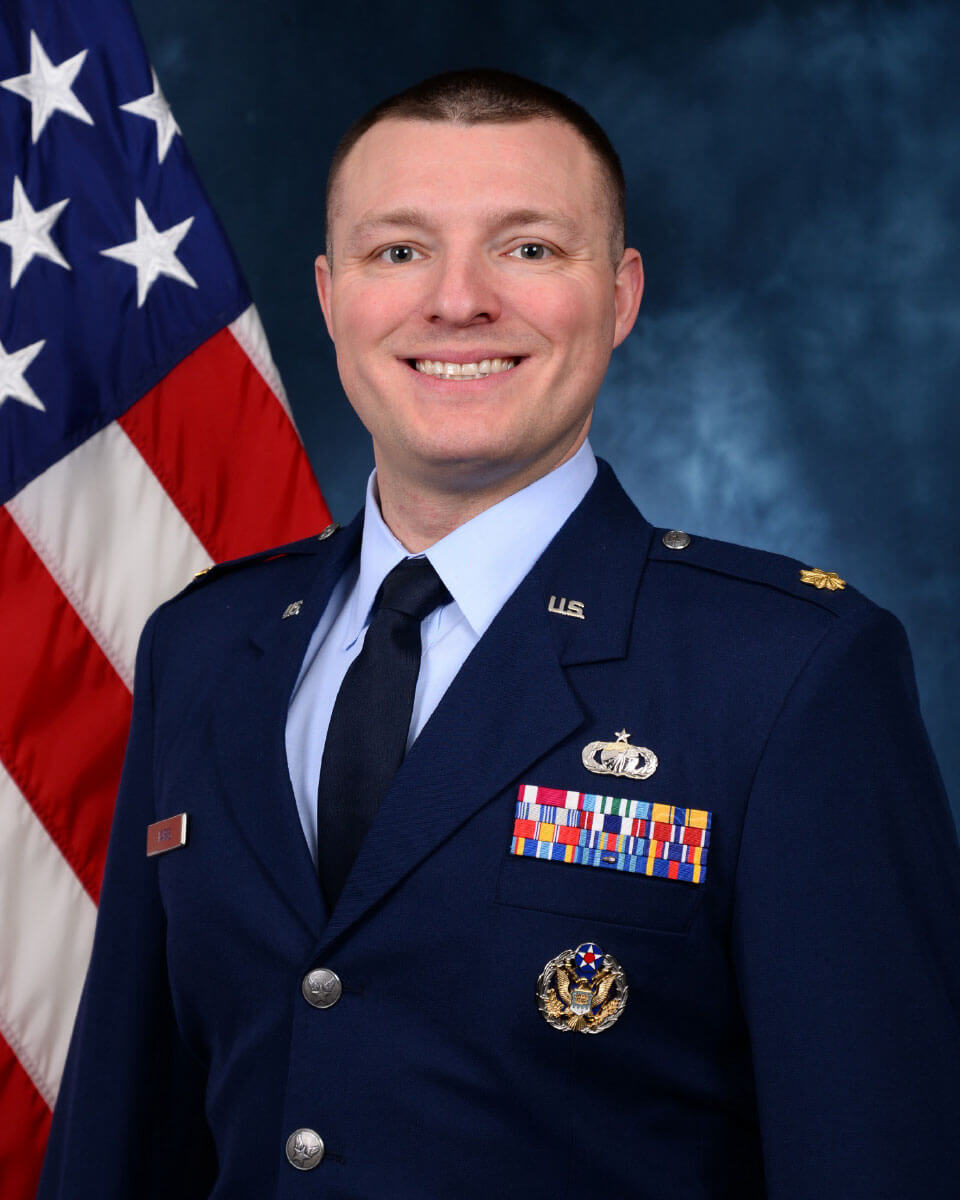
Major Scott Karas is an Assistant Professor in Chemistry at the U.S. Air Force Academy (USAFA). He instructs undergraduate chemistry courses and serves as the Assistant Director of Operations.
Maj Karas commissioned from Ohio University Reserve Officer Training Corps (ROTC) program in 2013, where he graduated with a Bachelor of Science in Biochemistry. His first assignment was Eglin Air Force Base, Fla. at the Air Force Research Laboratory as a High Explosive Research Chemist. In 2016, he earned a Master of Science in Chemistry from the University of Rhode Island through the Air Force Institute of Technology – Civilian Institution (AFIT-CI) program. Maj Karas served as a Chemical/Biological Program Analyst for the Joint Program Executive for CBRN Defense at Aberdeen Proving Ground, Md. In 2022, he earned his Doctor of Philosophy in Chemistry from the University of Virginia.
Prior to his current position, he served as a Program Element Monitor for the F-16, A-10, B-1, B-2, and Life Support Systems portfolios at the Directorate of Global Power Programs in the Office of the Secretary the Air Force (Acquisition), Headquarters U.S. Air Force, Washington D.C.
Education
Doctor of Philosophy, Chemistry, University of Virginia, Charlottesville, Va. (2022)
Master of Science, Chemistry, University of Rhode Island, Kingstown, R.I. (2016)
Bachelor of Science, Biochemistry, Ohio University, Athens, Ohio (2013)
Professional Experience
Instructor of Chemistry, U.S. Air Force Academy, Colo. (Current)
Program Element Monitor, Pentagon, Washington, D.C. (2022-2025)
AFIT-CI Student, University of Virginia, Charlottesville, Va. (2019-2022)
Chem/Biological Program Analyst, Aberdeen Proving Ground, Md. (2017-2019)
AFIT-CI Student, University of Rhode Island, Kingston, R.I. (2015-2016)
High Explosive Chemist, Eglin AFB, Fla. (2013-2015)
Honors & Awards
Meritorious Service Medal
Joint Service Commendation Medal
Air and Space Commendation Medal
Air and Space Achievement Medal
Meritorious Unit Award
Research and Scholarly Interests
Bioanalytical Chemistry
Publications
Woolf, M. S.; Dignan, L. M.; Karas, S. M.; Lewis, H. M.; Kim, S. N.; Geise, G. M.; DeMers, H. L.; Hau, D.; Gates-Hollingsworth, M. A.; AuCoin, D. P.; Landers, J. P. Digital Image Analysis for Biothreat Detection via Rapid Centrifugal Microfluidic Orthogonal Flow Immunocapture. Analytical Methods 2023, 15 (15), 1870–1880. https://doi.org/10.1039/D3AY00073G.
Dignan, L. M.; Karas, S. M.; Mighell, I. K.; Treene, W. R.; Landers, J. P.; Woolf, M. S. A Novel Method for Inward Fluid Displacement in Centrifugal Microdevices for Highly Integrated Nucleic Acid Processing with Long-Term Reagent Storage. Anal Chim Acta 2022, 1221. https://doi.org/10.1016/j.aca.2022.340063.
Woolf, M. S.; Dignan, L. M.; Karas, S. M.; Lewis, H. M.; Hadley, K. C.; Nauman, A. Q.; Geise, G. M.; Landers, J. P. Characterization of a Centrifugal Microfluidic Orthogonal Flow Platform. Micromachines (Basel) 2022, 13 (3). https://doi.org/10.3390/mi13030487.
Hane, F. T.; Fernando, A.; Prete, B. R. J.; Peloquin, B.; Karas, S.; Chaudhuri, S.; Chahal, S.; Shepelytskyi, Y.; Wade, A.; Li, T.; Deboef, B.; Albert, M. S. Cyclodextrin-Based Pseudorotaxanes: Easily Conjugatable Scaffolds for Synthesizing Hyperpolarized Xenon-129 Magnetic Resonance Imaging Agents. ACS Omega 2018, 3 (1), 677–681. https://doi.org/10.1021/acsomega.7b01744.